
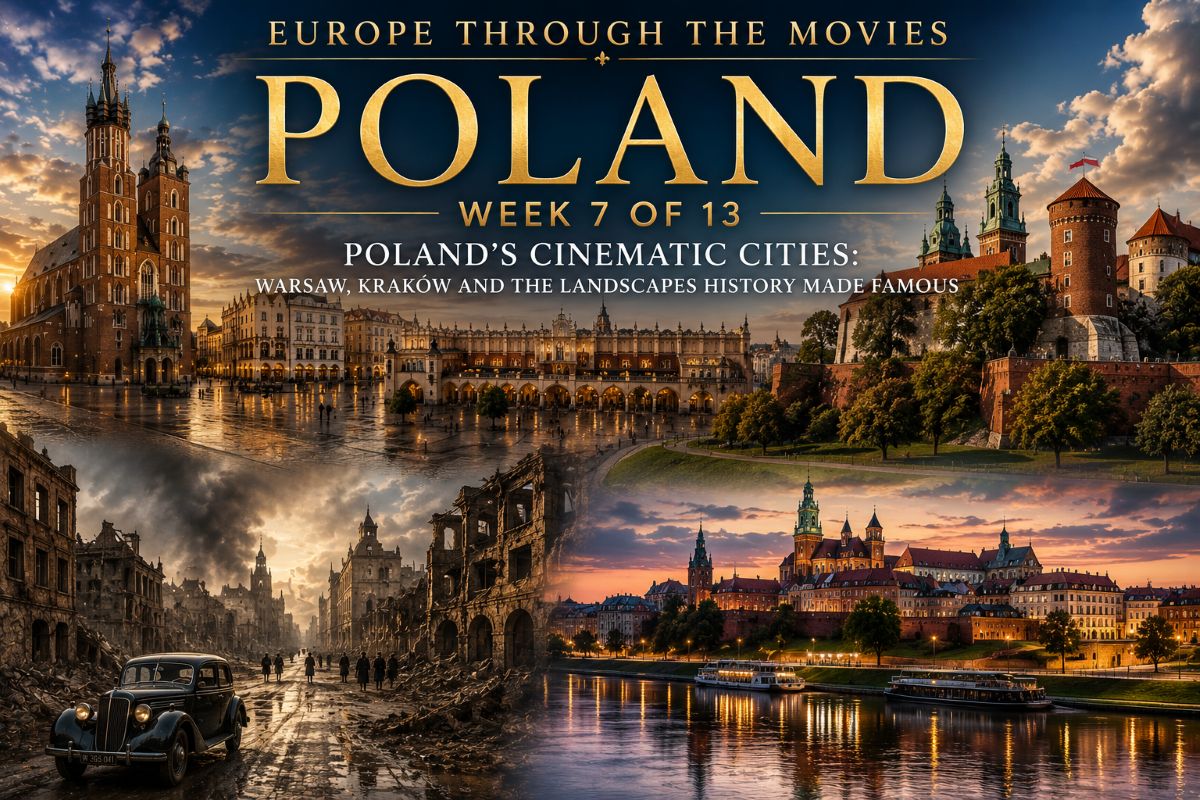
Poland occupies one of the most emotionally demanding positions in European screen history because some of its most iconic filming locations are bound not merely to fiction, but to the representation of events whose historical reality remains almost unbearable in scale. Kraków, Warsaw, Łódź and other Polish cities have been used by filmmakers attempting to reconstruct worlds damaged, erased or transformed by war, occupation and genocide, which means that the camera often enters locations already carrying a responsibility far greater than visual authenticity. Steven Spielberg’s Schindler’s List used Kraków and surrounding areas to represent the destruction of Jewish life under Nazi occupation, while Roman Polanski’s The Pianist recreated the Warsaw of his childhood and of Władysław Szpilman’s survival after much of the physical city associated with those events had been destroyed. To explore famous filming locations in Poland is therefore not simply to ask where celebrated films were made, but to confront the far more difficult question of how cinema should use real streets, factories, courtyards, stations and ruins when those places remain connected to historical trauma that fiction can interpret but never fully contain.
The power of Poland film tourism consequently lies in a tension unlike almost anything encountered earlier in this series, because the relationship between screen memory and historical memory is here unusually fragile. In Kraków, streets associated with Schindler’s List lead quickly beyond the film toward the history of the Jewish community that existed long before the production arrived and toward the machinery of occupation that attempted to destroy it; in Warsaw, the extraordinary postwar reconstruction of the city complicates the very idea of authenticity, because filmmakers depicting wartime Warsaw must sometimes recreate a city that was itself rebuilt after catastrophic destruction; in Łódź, industrial architecture and surviving urban fabric provide another form of historical continuity, revealing how Poland’s cities can become cinematic archives even when the original world surrounding them has changed radically. These are movie locations in Poland you can actually visit, but they resist the superficial logic of collecting recognizable frames because what matters most is not where an actor stood, but what happened in the real world before the actor arrived.
Following the most important filming locations in Poland therefore requires a different form of attention, one capable of holding cinema and history together without confusing them. The journey begins in Kraków, where Schindler’s List used surviving streets and districts to construct a devastating visual memory of occupation, before moving toward the factory associated with Oskar Schindler and the uncomfortable boundary between historical site and cinematic mythology, then continuing into Warsaw, where The Pianist confronted the near-erasure of an entire urban world and asked cinema to rebuild what history had destroyed, before reaching Łódź and the wider Polish production landscape through which international filmmakers have repeatedly found architecture capable of carrying the weight of Europe’s past. What emerges is not a celebration of Poland as scenery, but a study of how places become witnesses, how reconstruction can preserve and distort memory at the same time, and why some of the most powerful screen destinations in Europe are powerful precisely because the movies are not the most important thing that happened there.

Unlock the Entire Empowering Entertainment Library
This article is only the beginning.
Become a member and enjoy unlimited access to every premium magazine article, expert interviews, in-depth features, practical guides, and a growing digital library of hundreds of books covering business, entrepreneurship, film production, personal growth, health, relationships, AI, ADHD, and much more.
One membership. Hundreds of resources. New content added every week.