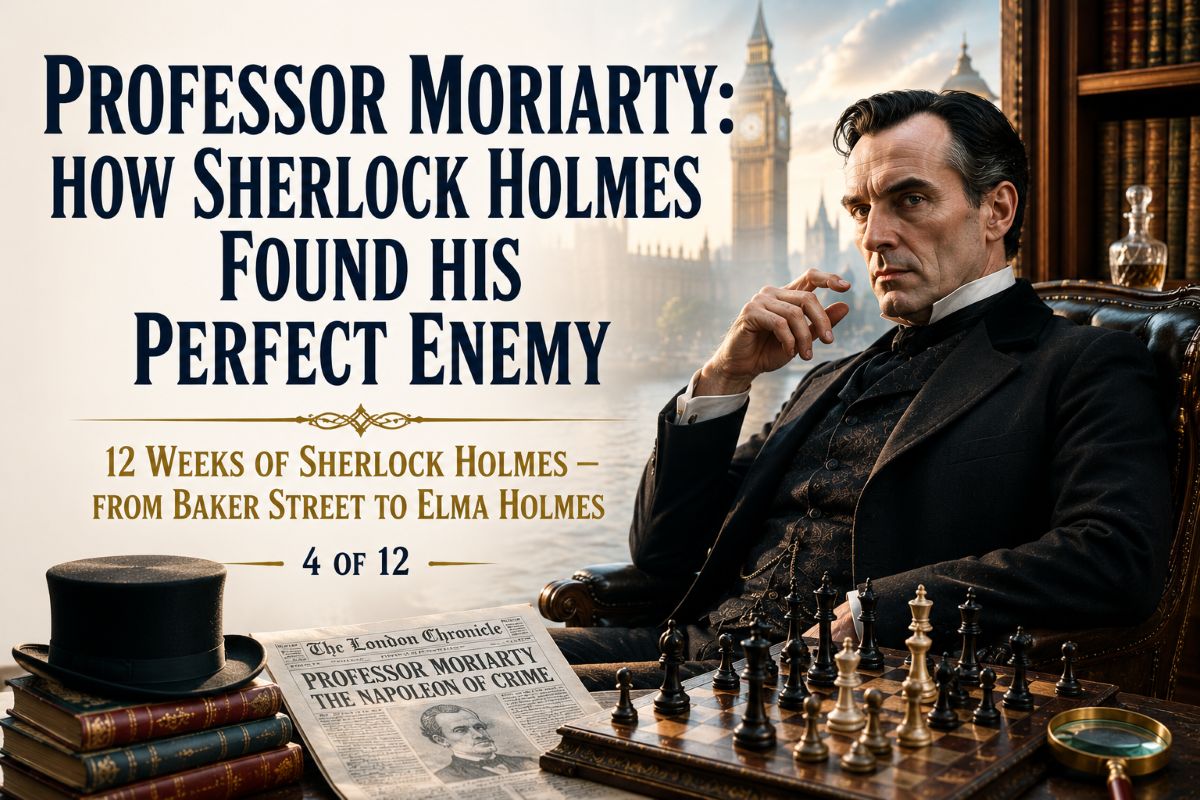
Professor James Moriarty occupies one of the strangest positions in the history of popular fiction: he is remembered as Sherlock Holmes's ultimate enemy despite appearing directly in remarkably little of Arthur Conan Doyle's original Sherlock Holmes canon, a paradox that reveals something profound about the architecture of enduring fictional antagonists. Introduced in The Final Problem in 1893, Moriarty does not need dozens of confrontations with Holmes to establish his power because Conan Doyle conceives him not merely as another criminal to be detected but as the intellectual opposite of the detective himself, a mathematical mind of extraordinary ability who has applied systematic reasoning to the organization of crime. Where Sherlock Holmes uses observation, knowledge and inference to expose hidden structures, Professor Moriarty uses comparable intelligence to construct structures designed to remain hidden, turning their conflict into something larger than the pursuit of a criminal by a detective. Holmes has finally encountered a man capable not simply of committing a crime he must solve, but of understanding the intellectual machinery through which Holmes solves crimes at all.
Get unlimited access to mystery movies and Sherlock Holmes books in the Vault at https://eevault.com. Also, read some of the greatest Sherlock Holmes mysteries here: https://www.empoweringentertainmentpublishing.com/books.
The relationship between Sherlock Holmes and Professor Moriarty consequently established one of the most influential rivalries in detective fiction, crime literature, cinema and television, creating the template for the brilliant hero confronted by an adversary whose danger comes from similarity rather than difference. Moriarty is frightening because he is not chaotic, impulsive or intellectually inferior; he is disciplined, strategic and capable of seeing the larger system behind individual events, which makes him one of the few figures in Conan Doyle's world who can force Holmes to become both hunter and hunted. Their confrontation at Reichenbach Falls in The Final Problem became legendary partly because Conan Doyle intended it to remove Sherlock Holmes from his own stories, yet the episode ultimately accomplished the opposite: by giving Holmes an enemy worthy of destroying him, Doyle elevated both characters into mythology, while the enormous public reaction to Holmes's apparent death demonstrated that the detective had already become culturally larger than the author who created him.
Understanding Professor Moriarty therefore requires us to look beyond the familiar idea of the "criminal mastermind" and examine why a character with such limited canonical presence could become inseparable from the Sherlock Holmes legend, why audiences instinctively elevate him above criminals who appear far more frequently, and why the greatest fictional enemies so often resemble distorted reflections of the heroes they oppose. The deeper story encompasses mathematics, Victorian anxieties about organized crime, Conan Doyle's growing frustration with his own creation, the psychology of intellectual rivalry, the extraordinary narrative power of an unseen enemy, the apparent death of Holmes at Reichenbach Falls, and the transformation of Moriarty through more than a century of adaptation. At its center lies a question that reaches beyond detective fiction itself: if extraordinary intelligence is morally neutral, what ultimately separates the mind capable of protecting civilization from the mind capable of mastering its criminal underworld?

Unlock the Entire Empowering Entertainment Library
This article is only the beginning.
Become a member and enjoy unlimited access to every premium magazine article, expert interviews, in-depth features, practical guides, and a growing digital library of hundreds of books covering business, entrepreneurship, film production, personal growth, health, relationships, AI, ADHD, and much more.
One membership. Hundreds of resources. New content added every week.