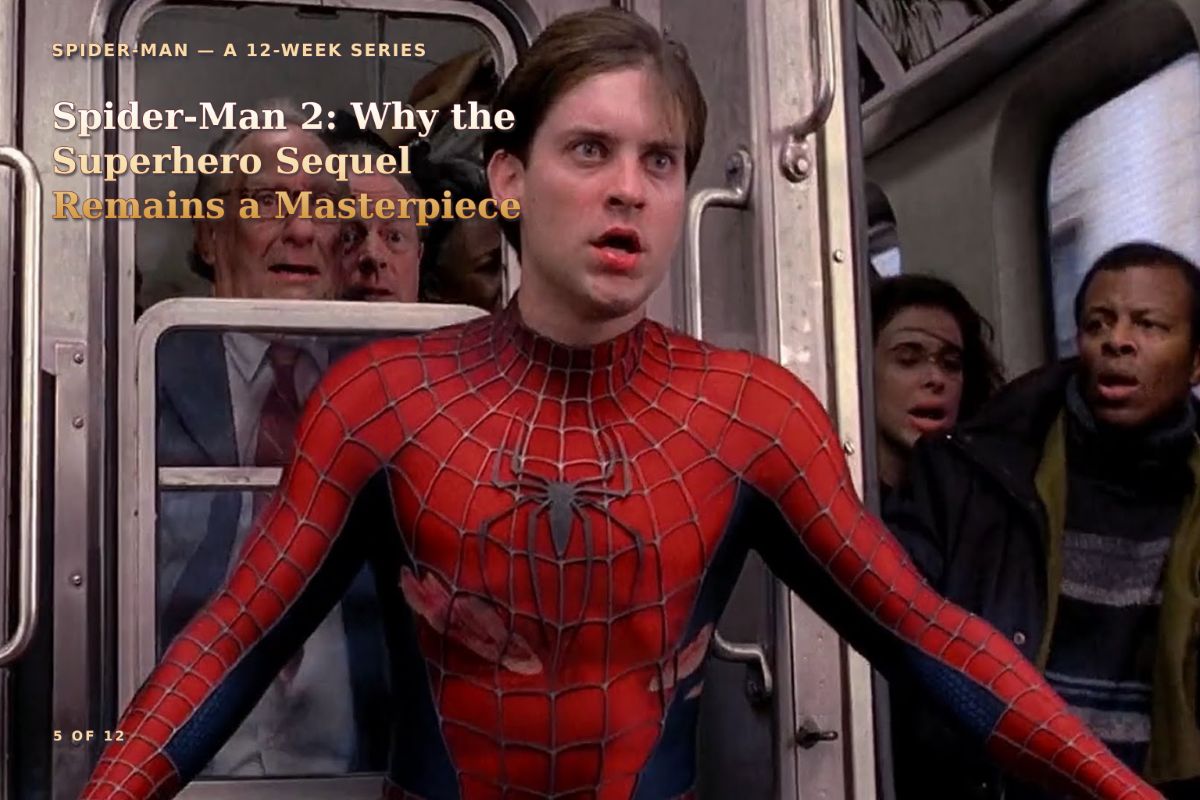
When Sam Raimi’s Spider-Man 2 arrived in theaters in June 2004, it accomplished something far more difficult than enlarging the commercial success of the first Spider-Man movie. The sequel transformed Peter Parker’s superhero identity from an exhilarating discovery into an unsustainable psychological burden, asking what happens after a young man has accepted great responsibility but has never learned how to live beneath its weight. Tobey Maguire returns as a Peter who is no longer discovering his powers but being gradually dismantled by them, unable to maintain his education, employment, friendships or relationship with Mary Jane Watson because every demand placed upon his ordinary life can be interrupted by someone else’s emergency. Alfred Molina’s Doctor Octopus provides the spectacular threat expected of a Spider-Man film, yet the deepest antagonist is exhaustion itself: the accumulating evidence that Peter cannot continue being available to everyone without eventually becoming absent from his own existence.
Frequently ranked among the greatest superhero movies ever made, Spider-Man 2 earned nearly $796 million worldwide, won the Academy Award for Best Visual Effects and received additional Oscar nominations for sound mixing and sound editing. Those achievements confirmed its technical and commercial power, but they do not fully explain why the film continues to carry such emotional authority decades after its release. The greatness of Spider-Man 2 lies in its refusal to romanticize sacrifice as an endlessly renewable resource. Peter’s powers begin to disappear not because a stronger villain has defeated him, but because his divided life has become psychologically impossible to sustain. His body expresses the truth his moral discipline refuses to acknowledge: he no longer knows whether Spider-Man is the meaningful purpose of his life or the identity through which that life is being consumed.
The story that follows examines Spider-Man 2 as a serious study of burnout, repression, vocation and the dangerous belief that goodness requires permanent self-erasure. It explores why Peter Parker loses his powers, how Doctor Octopus becomes a tragic mirror of ambition severed from conscience, why Aunt May’s understanding of heroism is more mature than Peter’s compulsive martyrdom and how the celebrated train sequence transforms anonymous passengers from spectators into guardians of the wounded man beneath the mask. At its deepest level, Spider-Man 2 does not ask whether Peter is strong enough to defeat Doctor Octopus; it asks whether he can recover a form of responsibility freely chosen rather than compulsively endured, and whether a hero who saves everyone else can finally accept that his own humanity is also something worth saving.

Unlock the Entire Empowering Entertainment Library
This article is only the beginning.
Become a member and enjoy unlimited access to every premium magazine article, expert interviews, in-depth features, practical guides, and a growing digital library of hundreds of books covering business, entrepreneurship, film production, personal growth, health, relationships, AI, ADHD, and much more.
One membership. Hundreds of resources. New content added every week.