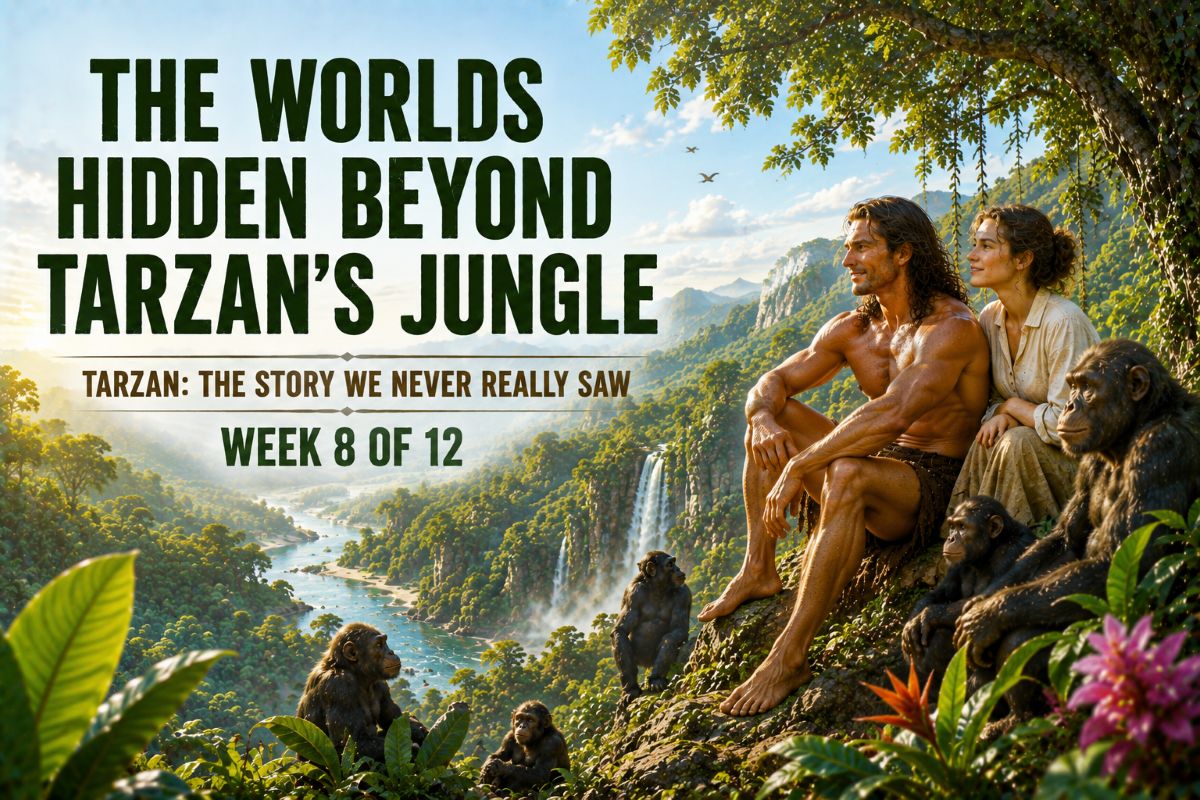
The future of Tarzan on screen depends upon confronting the past embedded inside Edgar Rice Burroughs’ original mythology, because no serious twenty-first-century adaptation can simply recover the character’s psychological complexity while ignoring the historical imagination through which Africa, race, civilization and empire were represented in the early novels. Tarzan emerged in 1912 from a Western literary culture saturated with colonial assumptions, racial hierarchies and fantasies of the so-called unexplored world, and those assumptions entered the stories at multiple levels: in the way African landscapes were exoticized, in the uneven depth granted to different peoples, in the relationship between European characters and indigenous societies, and in the broader idea that modern Western civilization possessed the authority to classify other cultures according to its own scale of advancement. Yet the difficulty is more complicated than simply declaring the material obsolete, because Burroughs simultaneously created a protagonist whose entire life destabilizes the claim that civilization automatically equals moral superiority. Tarzan repeatedly discovers courage, loyalty, cruelty, corruption and nobility across boundaries that civilized society would prefer to treat as absolute, which means the mythology contains both the prejudices of its historical moment and elements capable of challenging the very hierarchy from which those prejudices emerged.
Watch classic Tarzan movies and TV series by joining the EE Vault. Click here for more information.
This contradiction is central to any discussion of a new Tarzan movie, Tarzan remake or modern adaptation of Tarzan of the Apes, because the solution cannot be to preserve the old racial and colonial assumptions in the name of fidelity, nor can it be to remove Africa’s cultural and political complexity until the continent becomes a visually impressive but historically empty backdrop. Both approaches would repeat the same underlying failure by treating Africa as something organized around Tarzan rather than as a world populated by societies, histories, interests and conflicts that exist independently of him. The Waziri, Opar and the many African communities encountered across the books become considerably more compelling when they are granted agency equal to their narrative importance, and Tarzan himself becomes more interesting when he is forced to enter worlds he does not possess the right to define. A modern adaptation capable of making that shift would preserve the central quality that has made Tarzan psychologically powerful from the beginning—his ability to move between systems without belonging entirely to any of them—while removing the assumption that his exceptional position grants him automatic authority over everyone he encounters.
The real challenge, then, is not whether Tarzan can survive modern scrutiny, but whether filmmakers are willing to understand that scrutiny as an opportunity for deeper storytelling rather than an obstacle to adventure. A truly ambitious adaptation would allow the character’s divided identity to collide with the colonial history surrounding him, asking what it means for an English aristocrat formed in Africa to love a continent that is not his to possess, how loyalty differs from ownership, why admiration does not erase asymmetry, and whether Tarzan’s instinctive distrust of civilized hypocrisy can eventually extend toward the imperial structures from which his own inherited privilege originates. Examined at that level, the historical problem stops being something modern filmmakers must conceal and becomes one of the richest dramatic tensions available in the mythology, because Tarzan can only become genuinely relevant again if the story is willing to ask not merely whether he belongs in Africa, but what belonging itself means when history, power and identity are no longer permitted to remain invisible.
Unlock the Entire Empowering Entertainment Library
This article is only the beginning.
Become a member and enjoy unlimited access to every premium magazine article, expert interviews, in-depth features, practical guides, and a growing digital library of hundreds of books covering business, entrepreneurship, film production, personal growth, health, relationships, AI, ADHD, and much more.
One membership. Hundreds of resources. New content added every week.