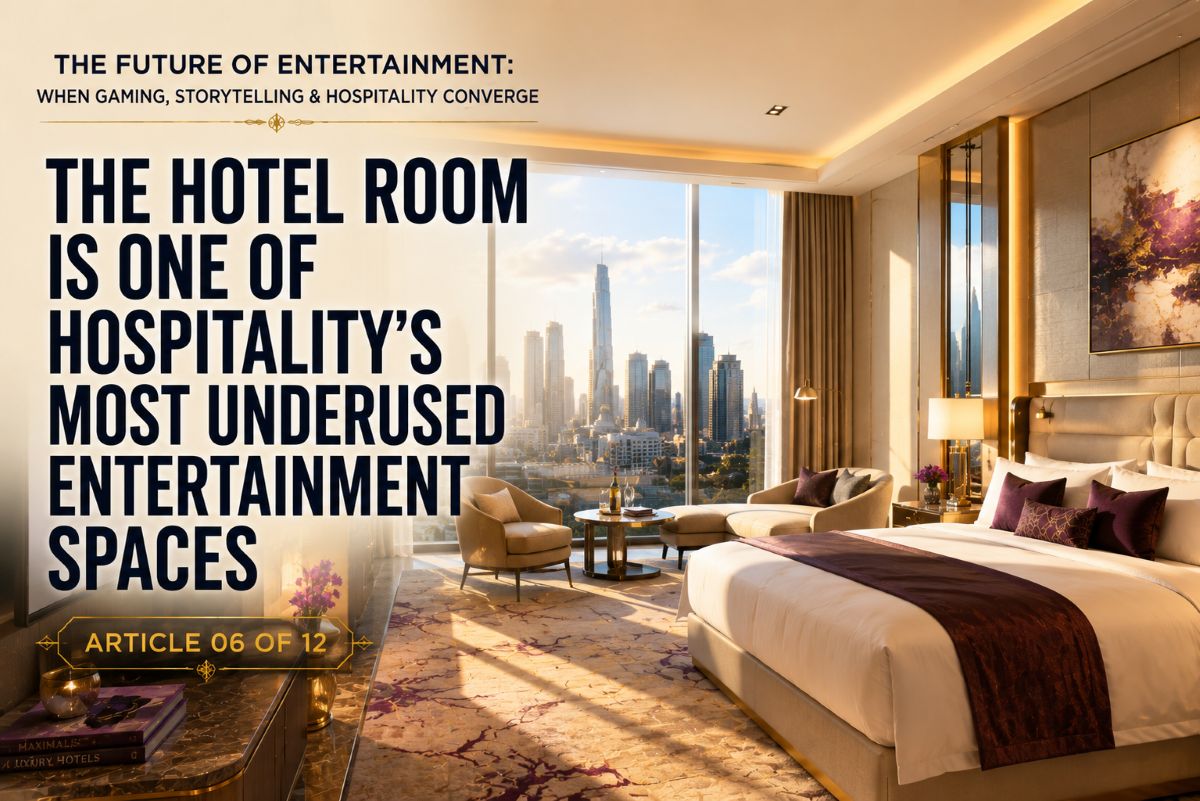
For more than a century, the hotel industry has continuously reinvented luxury while leaving the fundamental purpose of the hotel room remarkably unchanged. Beds have become more comfortable, bathrooms more elaborate, technology more integrated, service more personalized and interior design increasingly sophisticated, yet the room remains primarily a beautifully engineered place in which guests sleep, prepare themselves, work, relax and store their belongings between the experiences that motivated the journey. Even in resorts built around entertainment destinations, the most important entertainment frequently occurs somewhere else, while the hotel room functions as the place to which the guest retreats when the day's experiences are over. Yet as experiential hospitality, immersive entertainment, gaming, movie IP, interactive storytelling, role-play and entertainment hotels begin moving toward one another, this apparently ordinary space may become one of the most strategically important frontiers in the next generation of entertainment because the room possesses something most attractions cannot offer: privacy, duration, intimacy and repeated access to the same participant across an entire stay.
The opportunity extends far beyond movie-themed bedrooms, branded décor, interactive televisions or gaming consoles because these additions change what guests can see or do inside a room without fundamentally changing what the room is. A genuinely immersive hotel room could operate simultaneously as accommodation, narrative environment, private stage, interactive interface and persistent point of continuity within a larger fictional world, allowing events elsewhere in the property to acquire consequences that follow the guest back into what would traditionally have been neutral space. Objects could gain meaning as stories develop, lighting and sound could respond to narrative states, information discovered elsewhere could unlock experiences inside the room, and events occurring overnight could alter what guests encounter when they wake, creating a relationship between hotel technology, game design, artificial intelligence, movie intellectual property and immersive hospitality that is fundamentally different from placing entertainment amenities inside conventional accommodation.
The deeper significance lies in what happens when the entire hotel is reconsidered through the same lens, because rooms do not exist independently from corridors, elevators, restaurants, bars, gardens, pools, lobbies and the thousands of transitions connecting them. Hospitality already controls an extraordinary sequence of physical environments through which guests naturally move for hours or days, yet almost all of that movement remains narratively unused, leaving entertainment concentrated into designated venues rather than embedded within the experience of inhabiting the property itself. If the next generation of destination entertainment is to move beyond watching fictional worlds toward participating inside them, then understanding the hotel as narrative architecture rather than merely accommodation becomes essential, and that transformation begins with the most private, emotionally powerful and commercially valuable space the property already possesses: the room in which the guest actually lives.

Unlock the Entire Empowering Entertainment Library
This article is only the beginning.
Become a member and enjoy unlimited access to every premium magazine article, expert interviews, in-depth features, practical guides, and a growing digital library of hundreds of books covering business, entrepreneurship, film production, personal growth, health, relationships, AI, ADHD, and much more.
One membership. Hundreds of resources. New content added every week.