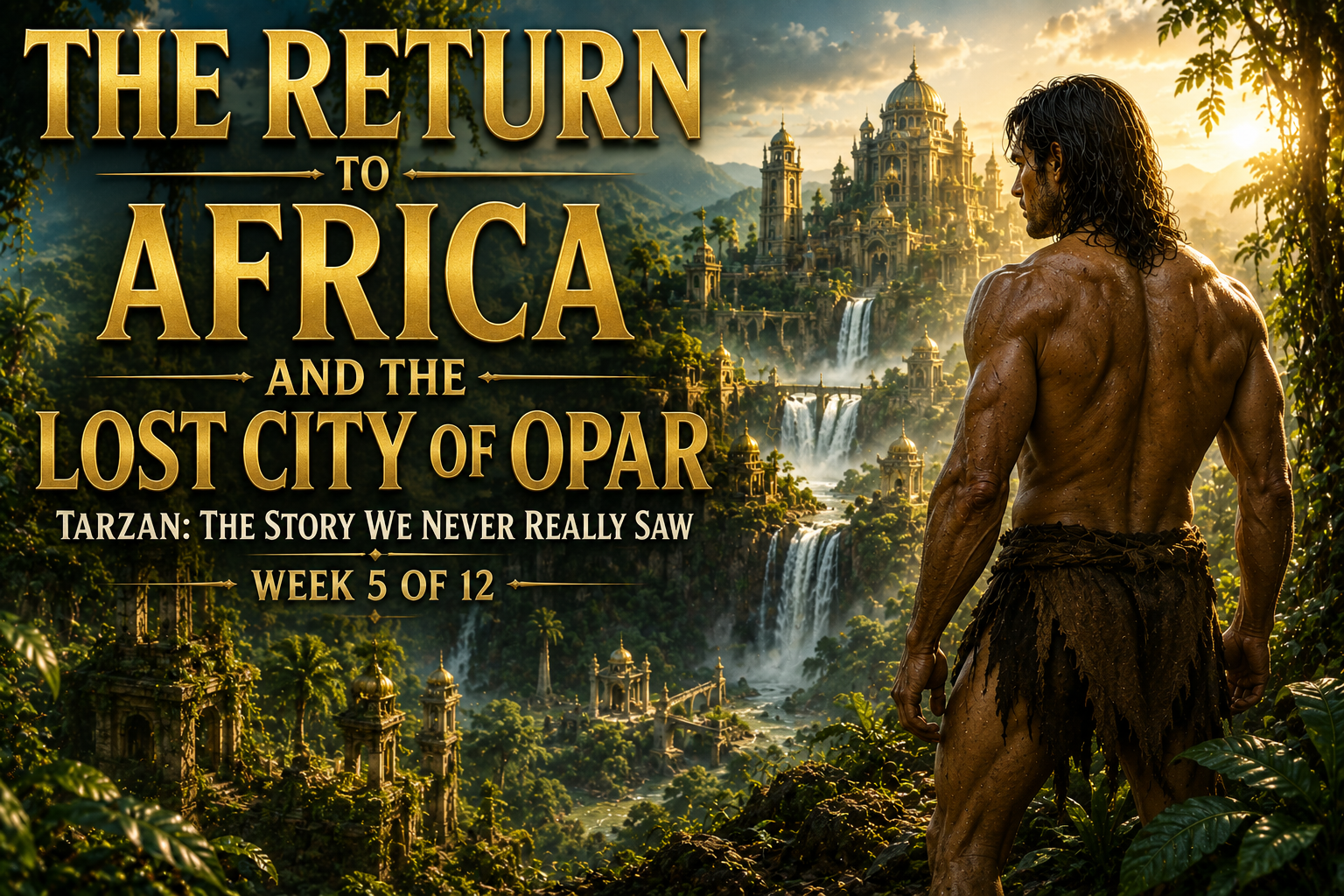
The return of Tarzan to Africa in Edgar Rice Burroughs' novels is one of the most important turning points in the entire mythology because it reveals that civilization has expanded Tarzan without replacing him, and that the identity of Lord Greystoke can never fully contain the man formed beyond its boundaries. By the time Tarzan moves back toward Africa, he no longer returns as the orphaned child who knew no other world, but as someone who has experienced Europe, aristocratic society, language, political intrigue and the emotional complication of loving Jane Porter; his return therefore cannot be understood as regression, because one cannot return psychologically to a place one now sees differently. Africa has become more than origin. It has become a chosen dimension of identity, and that distinction transforms the mythology from a story of survival into a story of belonging consciously reaffirmed after alternatives have become available. The Tarzan books by Edgar Rice Burroughs begin expanding at precisely this point, because the landscape that once represented childhood and instinct becomes the gateway to new communities, ancient mysteries and civilizations that challenge the assumption that the modern European world possesses any monopoly on history, complexity or power.
Watch classic Tarzan movies and TV series by joining the EE Vault. Click here for more information.
That expansion becomes most visible through the Waziri and the lost city of Opar, two elements that dramatically enlarge the world surrounding Tarzan while deepening the central questions already embedded in his character. The Waziri allow Tarzan's relationship with Africa to move beyond the Mangani and beyond the solitary mythology of the jungle, creating bonds based upon alliance, mutual respect and chosen loyalty rather than merely childhood circumstance, while Opar introduces a different order of reality altogether: a hidden civilization, ancient treasure, ritual authority and the haunting suggestion of a past buried beneath the surface of the known world. Opar matters because it shifts Tarzan from the border between jungle and Europe into a mythology of multiple civilizations, each carrying its own logic, history and claim upon human imagination, and Burroughs thereby transforms the series from an unusual adventure narrative into something much closer to a sustained lost-world epic. The man who once struggled to understand the mystery of his own hidden ancestry now enters places that carry hidden histories of their own, and the parallel is too powerful to dismiss as mere decoration.
What makes Opar, La and the Waziri essential to understanding the real Tarzan story is therefore not the novelty of adding treasure, forgotten cities and new allies, but the way each element intensifies the character's deepest psychological tensions. The Waziri raise the question of chosen community, Opar confronts Tarzan with the seduction and danger of civilizations outside the familiar binary of jungle and Europe, and La introduces a form of power and attraction radically different from Jane Porter, testing whether Tarzan's developing sense of self can remain stable when another world offers him recognition on completely different terms. Once these threads are followed carefully, the mythology begins to reveal something Hollywood has rarely exploited to its full potential: Tarzan is not simply a hero belonging to one jungle, but a character structurally designed to cross cultures, histories, genres and moral systems, carrying the unresolved question of identity into every world he enters.

Unlock the Entire Empowering Entertainment Library
This article is only the beginning.
Become a member and enjoy unlimited access to every premium magazine article, expert interviews, in-depth features, practical guides, and a growing digital library of hundreds of books covering business, entrepreneurship, film production, personal growth, health, relationships, AI, ADHD, and much more.
One membership. Hundreds of resources. New content added every week.