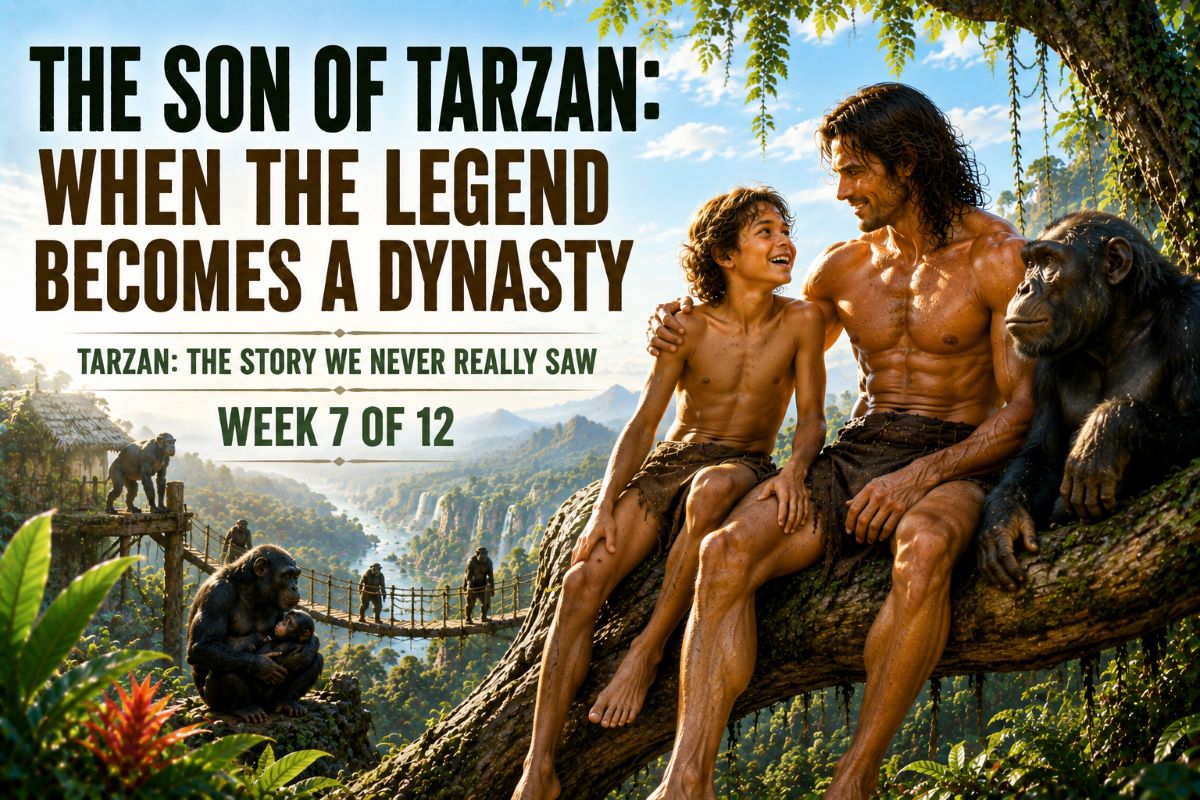
The story of Tarzan's son, Jack Clayton, in Edgar Rice Burroughs' The Son of Tarzan performs one of the most intelligent reversals in the entire Tarzan mythology because the child who will eventually become known as Korak travels psychologically in the opposite direction from his father. Tarzan begins life in Africa without knowledge of his human ancestry, develops his identity among the Mangani and only later discovers John Clayton, Lord Greystoke, while Jack begins inside the civilized world with parents, language, social identity and the enormous inheritance of a father whose extraordinary past already exists before the son has begun constructing a meaningful identity of his own. Their stories therefore resemble one another only superficially. Tarzan had to discover where he came from after becoming himself, whereas Jack must discover who he is while already knowing exactly where he came from, and that difference transforms The Son of Tarzan from a repetition of the original jungle adventure into a psychologically rich story about inheritance, parental fear, individuation and the dangerous weight of growing up beneath a legendary parent.
Watch classic Tarzan movies and TV series by joining the EE Vault. Click here for more information.
The origin of Korak in the Tarzan books also complicates one of the central assumptions surrounding Tarzan himself, because the qualities forged through an extraordinary childhood cannot simply be transmitted through blood. Jack may inherit physical potential, temperament, social position and the mythology of Greystoke, but he cannot inherit his father's memories, and therefore he cannot become Tarzan merely by entering the same landscape. The jungle means something entirely different to a boy raised in civilization than it did to an orphan who knew no alternative, while danger deliberately approached carries a different psychological meaning from danger imposed by circumstance. This distinction forces Tarzan into one of the most difficult positions of his adult life: the man who resisted civilization's attempts to define and contain him must now decide how much authority he is entitled to exercise over a son developing the same appetite for independence, and the father who built his identity through freedom discovers that freedom becomes much more frightening when it belongs to someone he loves.
To understand why Korak, the Son of Tarzan, could be essential to a modern Tarzan film or television franchise, we therefore have to move beyond the obvious appeal of introducing a second jungle hero and examine the generational conflict Burroughs created beneath the adventure. Jack Clayton inherits not one identity but several—the civilized child, the Greystoke heir, Tarzan's son and eventually Korak—and each contains expectations capable of overwhelming the person attempting to live inside them. His journey becomes a question familiar far beyond adventure fiction: how does a child admire a powerful parent without becoming a copy, how does a parent protect a child without turning protection into possession, and what happens when the very independence celebrated in one generation becomes terrifying when it reappears in the next? The story of Korak matters because it transforms the Tarzan mythology from the story of one extraordinary man's self-creation into an examination of whether identity can ever truly be inherited, or whether every generation must ultimately earn the right to name itself.

Unlock the Entire Empowering Entertainment Library
This article is only the beginning.
Become a member and enjoy unlimited access to every premium magazine article, expert interviews, in-depth features, practical guides, and a growing digital library of hundreds of books covering business, entrepreneurship, film production, personal growth, health, relationships, AI, ADHD, and much more.
One membership. Hundreds of resources. New content added every week.