
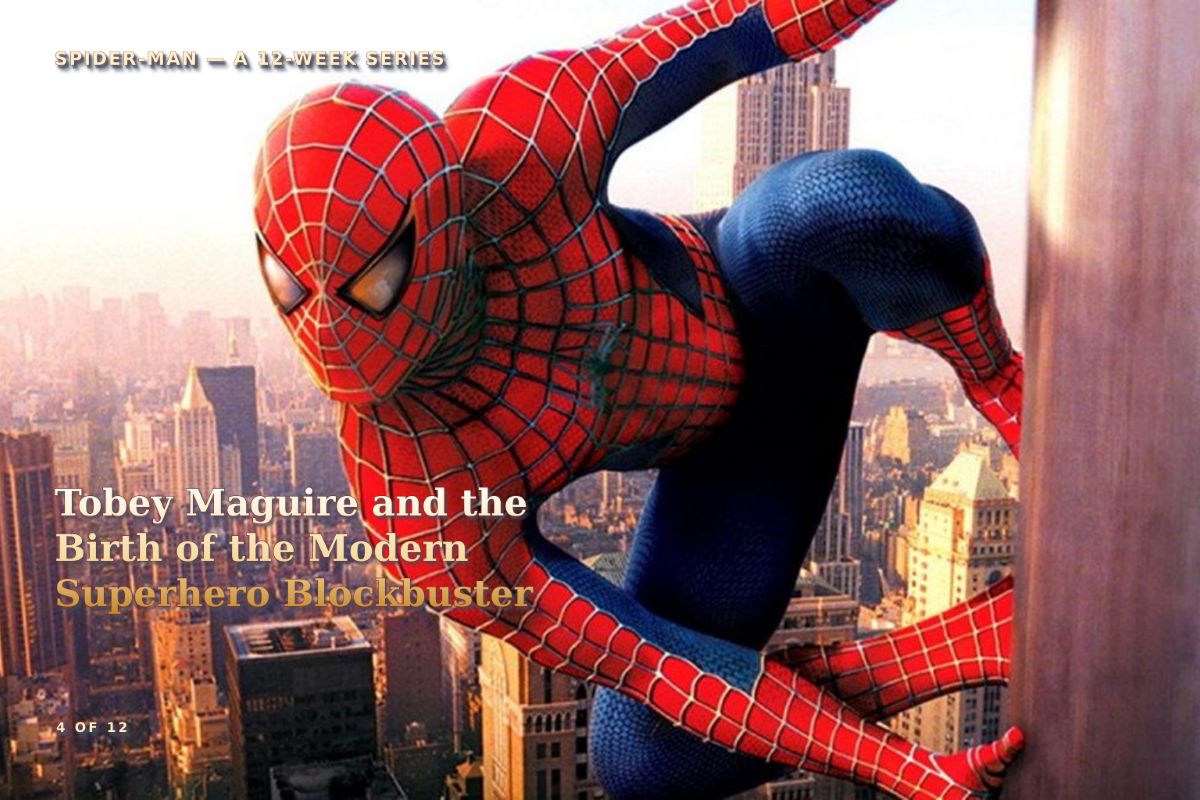
When Sam Raimi’s Spider-Man opened in American theaters on May 3, 2002, it did more than give Marvel’s most popular hero the live-action spectacle previous filmmakers had been unable to achieve. Starring Tobey Maguire as Peter Parker, Kirsten Dunst as Mary Jane Watson and Willem Dafoe as Norman Osborn and the Green Goblin, the film became the first movie in history to earn more than $100 million during its domestic opening weekend, ultimately reaching approximately $826 million worldwide. Its commercial success announced that a comic-book adaptation could stand among Hollywood’s largest cultural events, while its emotional seriousness demonstrated that the modern superhero blockbuster did not need to choose between visual spectacle and intimate human vulnerability. After four decades of animated series, live-action television experiments and abandoned Spider-Man movie projects, Hollywood had finally discovered how to make audiences believe not only that Spider-Man could swing across New York City, but that Peter Parker might be emotionally destroyed by everything the costume required of him.
The enduring power of Spider-Man cannot be explained solely by the technical achievement of its web-swinging sequences or by the novelty of seeing a beloved Marvel Comics character realized with a major studio budget. Sam Raimi understood that the emotional foundation created by Stan Lee and Steve Ditko depended upon sincerity: Peter Parker had to be lonely without becoming cynical, morally compromised without becoming unworthy of redemption and transformed by power without ceasing to be the socially uncertain young man who had spent years watching life from its margins. Tobey Maguire’s performance rejected the effortless charisma that might have made Peter conventionally heroic, allowing awkwardness, longing and humiliation to remain visible inside the origin story. His Spider-Man was not a fantasy of instant self-possession but a portrait of a young man discovering that physical power could enlarge his choices without resolving the insecurity from which those choices emerged.
To understand why Spider-Man became one of the defining superhero movies of the twenty-first century, it is necessary to look beyond its box-office records and reconsider the artistic intelligence hidden beneath its apparent simplicity. The film’s exploration of masculinity, class, desire, guilt and responsibility gave extraordinary emotional consequence to Peter Parker’s transformation, while Willem Dafoe’s Norman Osborn embodied the dangerous fantasy of power released from conscience. The analysis that follows examines how Sam Raimi transformed comic-book imagery into cinematic language, why Tobey Maguire’s vulnerability became the film’s greatest strength, how the death of Uncle Ben gave the blockbuster its moral center and why the final rejection of Mary Jane established that Spider-Man’s first great victory would also become Peter Parker’s first conscious act of self-denial.

Unlock the Entire Empowering Entertainment Library
This article is only the beginning.
Become a member and enjoy unlimited access to every premium magazine article, expert interviews, in-depth features, practical guides, and a growing digital library of hundreds of books covering business, entrepreneurship, film production, personal growth, health, relationships, AI, ADHD, and much more.
One membership. Hundreds of resources. New content added every week.