

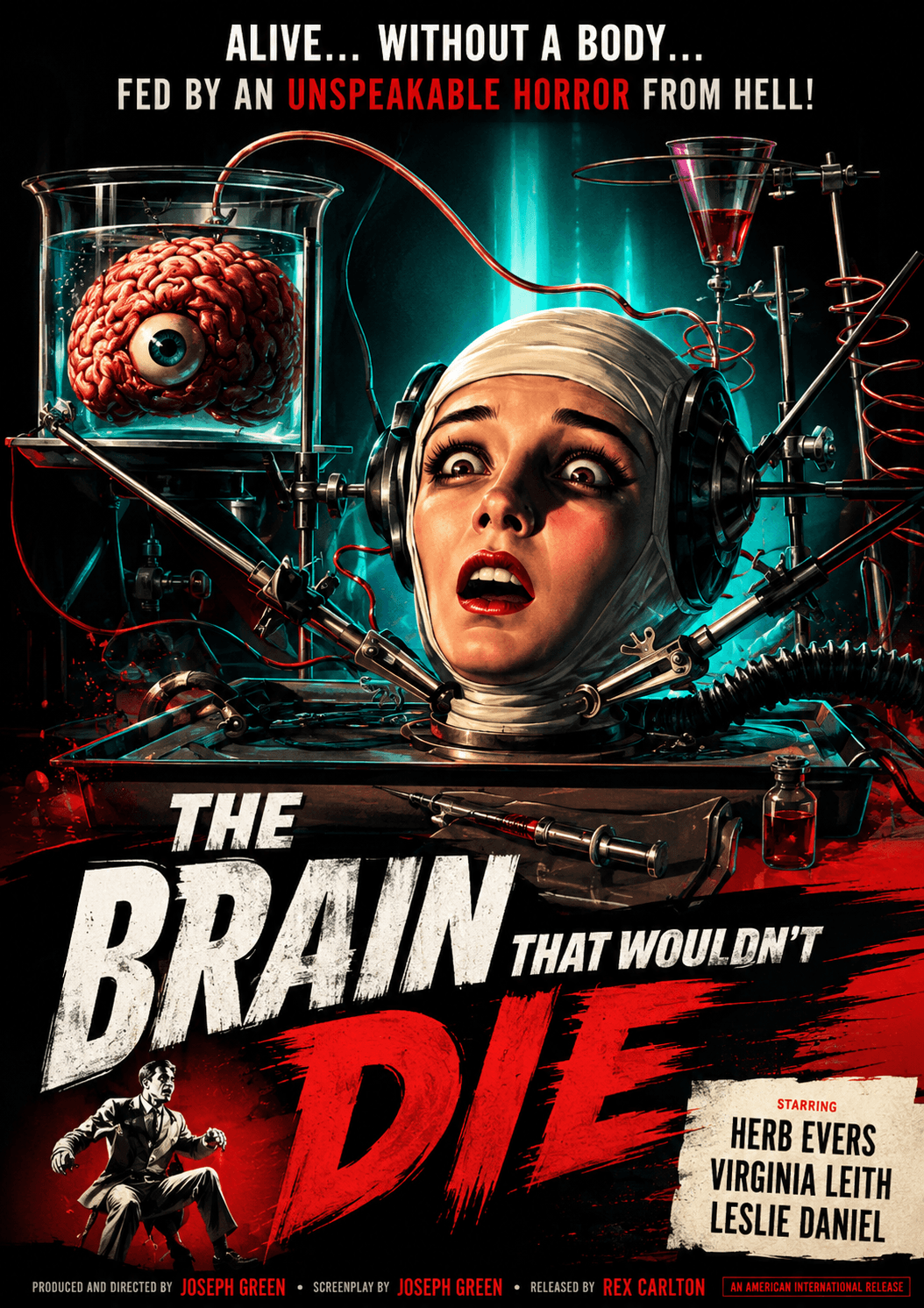
A Monster Film in Which the Scientist Is the True Threat
When The Brain That Wouldn’t Die reached theaters in 1962, it entered a cinematic landscape already crowded with reckless scientists, forbidden experiments, radioactive mutations, and medical discoveries that transformed human ambition into physical horror. Yet Joseph Green’s independent science-fiction film remains unusually disturbing because its central experiment is not performed upon an anonymous creature created in a laboratory. It is performed upon a conscious woman who repeatedly understands what is being done to her, clearly refuses it, and is deliberately denied the right to die by the man who claims to love her.
Directed by Joseph Green from a screenplay he wrote with producer Rex Carlton, the film stars Virginia Leith as Jan Compton and Jason Evers, credited at the time as Herb Evers, as Dr. Bill Cortner. Although the production was completed several years before its eventual theatrical release, the American Film Institute records the film as a May 1962 horror feature centered on a surgeon who keeps his decapitated fiancée alive while searching for another woman’s body to attach to her head. (AFI Catalog) The premise sounds sensational, and the film embraces the visual excess expected from low-budget exploitation cinema, but beneath its laboratory equipment, disembodied head, deformed creature, and lurid search for a replacement body lies a surprisingly coherent examination of medical power without consent.
Bill Cortner believes that his technical ability gives him the right to determine the limits of another person’s existence. Jan does not ask to be preserved, does not agree to an experimental transplant, and does not regard survival at any cost as a gift. Her wishes are explicit, yet Bill treats those wishes as emotional obstacles to be managed rather than as decisions belonging to the person whose life he has seized. The film’s true horror therefore emerges not from the impossible fact that a severed head remains conscious, but from the entirely recognizable danger of a powerful man who interprets another person’s body as material for his ambition.
The Accident That Becomes an Opportunity
The story begins after Bill has already established himself as a talented but ethically reckless surgeon whose transplant experiments exceed the boundaries accepted by his father and professional colleagues. His scientific ability is genuine, which makes him more dangerous rather than less, because incompetence would limit the consequences of his arrogance. Bill possesses enough knowledge to violate natural limits while lacking the humility required to ask whether every technically possible action should be performed.
After an automobile accident decapitates Jan, Bill does not respond only as a grieving fiancé confronting sudden loss. He responds as an experimental surgeon who sees an unprecedented opportunity. He retrieves her head, carries it to his secluded laboratory, and uses his research to maintain circulation and brain function, converting catastrophe into the experiment toward which his previous work had been moving.
This transformation of grief into opportunity is central to the character. Bill may sincerely believe that preserving Jan demonstrates love, but his behavior quickly reveals that scientific ambition and personal attachment have become inseparable. Saving her allows him to avoid loss, but it also allows him to prove that his theories were correct. Jan becomes simultaneously his fiancée, patient, experiment, possession, and evidence of professional genius.
The collision therefore does not create Bill’s moral corruption. It removes the restraints that had previously limited its expression. Before the accident, he experimented upon bodies obtained through questionable means and pursued transplantation without adequate ethical control. After the accident, emotional urgency provides the justification he needs to extend those practices to the person closest to him.
The film’s psychological insight lies in showing how easily personal devotion can disguise domination. Bill does not perceive himself as a villain because he can describe every violation as an attempt to save Jan. Yet the language of rescue becomes morally empty once the person being rescued has explicitly rejected the form that rescue takes.
Jan Compton and the Prison of Conscious Survival
Jan’s condition is one of the most grotesque images in early body horror: her head rests in a tray surrounded by wires, tubes, chemical equipment, and machinery that keeps her biologically functioning without the rest of her body. She can speak, think, remember, feel anger, and understand the horror of her situation, but she possesses almost no ability to act upon the world around her.
The arrangement converts consciousness into imprisonment. Jan remains alive according to Bill’s medical definition, yet nearly every capacity through which life becomes self-directed has been removed. She cannot walk away, physically resist, control her treatment, seek independent help, or even end the existence she considers intolerable. Her survival is therefore entirely separated from autonomy.
Virginia Leith’s performance gives the film much of its lasting force because Jan does not behave like a grateful victim waiting to be restored. She is furious, lucid, contemptuous, and increasingly aware that Bill’s supposed devotion has reduced her to an object. Her anger prevents the character from becoming merely a special effect and gives moral language to the violation at the center of the story.
Jan understands something Bill refuses to accept: biological continuation is not automatically equivalent to meaningful life. He treats a functioning brain as proof that he has defeated death, while she experiences the same condition as evidence that death has been interrupted without life being restored. The disagreement is not about whether his experiment works. It is about who possesses the authority to define success.
Bill measures success through preservation, technical possibility, and future reconstruction. Jan measures it through dignity, bodily integrity, consent, and the capacity to determine her own existence. The film may present the conflict through sensational horror, but the ethical question is profound: does the person who can prolong life acquire the right to prolong it against the patient’s will?
The Right to Refuse the Miracle
Bill repeatedly assumes that Jan’s objections are temporary reactions to trauma. He expects that once he finds an attractive body and completes the transplant, she will eventually appreciate what he has done. This belief allows him to disregard her present refusal by appealing to the future person he imagines she will become.
Such reasoning is dangerous because it transforms consent into something the powerful person can postpone until the desired result has been achieved. Bill does not need Jan to agree now because he believes success will retroactively justify the violation. Her future gratitude becomes an imaginary authorization for actions she explicitly rejects in the present.
The structure resembles many forms of coercion in which one person claims superior knowledge of another’s needs. The controlling individual does not necessarily deny that resistance exists; he reinterprets resistance as confusion, fear, irrationality, or lack of imagination. The victim’s words are heard but stripped of authority.
Jan’s demand to be allowed to die is therefore more than despair. It is an attempt to reclaim ownership over the only decision still available to her. Bill has taken control of her circulation, environment, future body, and access to the world, leaving refusal as her final expression of personhood.
His inability to respect that refusal exposes the selfishness beneath his rescue fantasy. Bill is not merely preserving Jan for Jan. He is preserving her because he cannot tolerate losing her, cannot abandon the experiment, and cannot accept a reality in which his skill has limits. Her continued consciousness serves his emotional and professional needs even while it becomes unbearable to her.
The miracle is therefore horrifying because it has no exit. Medical achievement becomes a form of captivity when the person sustained by it is denied both control over treatment and the right to reject what others define as salvation.
Love Reconstructed as Ownership
Bill’s relationship with Jan becomes increasingly revealing as he speaks about the body he intends to find for her. He does not imagine that she might participate in selecting that body, reconsider the procedure, or determine what form of life she is willing to accept. He assumes responsibility for the entire decision because he regards himself as both creator and owner of her future.
His search is often described as an attempt to find a suitable donor, but the language of donation would be misleading. The women he considers have not consented to sacrifice their bodies. Bill intends to obtain one through deception, abduction, and murder, demonstrating that Jan’s reconstruction requires another woman’s destruction.
This arrangement reveals the violence hidden inside his idea of romantic restoration. He wants to rebuild the woman he loves, but he is willing to do so by reducing an unknown woman to biological material. Jan’s personhood matters to him because she belongs to his emotional world, while the bodies of other women matter only as resources.
Love therefore becomes a system of unequal human value. Bill’s attachment to one woman does not deepen his respect for human life; it authorizes him to violate others. His devotion is intense but ethically narrow, protecting the person he claims as his own while erasing the rights of anyone who might serve his purpose.
The film exposes the difference between love and possession through this contradiction. Love recognizes another person as a separate center of choice, while possession values the person according to the role she plays within the possessor’s needs. Bill wants Jan alive, beautiful, restored, and available to him, but he repeatedly refuses to recognize her as someone entitled to disagree with the future he has designed.
The Search for the Perfect Body
After leaving Jan in the laboratory, Bill enters nightclubs, streets, beauty competitions, and artists’ studios while evaluating women as possible sources of a replacement body. His gaze transforms public spaces into a private anatomical market. He does not encounter complete human beings with histories, relationships, vulnerabilities, and ambitions. He sees physical structures that may be assessed, compared, and appropriated.
The film’s treatment of these scenes contains the exploitative spectacle associated with its era, yet that spectacle also serves the story’s moral ugliness. Bill studies bodies while ignoring the consciousness within them, reproducing the same separation already embodied by Jan’s condition. Jan has been reduced to a mind without a body, while the women he observes are reduced to bodies without minds.
This division creates the film’s central symbolic structure. Bill imagines personhood as something that can be assembled from interchangeable components, provided the surgical connection succeeds. Jan’s head contains the identity he values, while another woman’s body supplies the physical beauty and mobility he wants restored.
Yet bodies are not neutral containers. They carry memory, sensation, vulnerability, social identity, and personal meaning. Bill’s project fails ethically before any surgical difficulty arises because it assumes that one woman’s body can be detached from her personhood and transferred to another without moral remainder.
His search for physical perfection also reveals that the experiment is not governed solely by medical compatibility. He wants a body that satisfies aesthetic standards, reinforcing the sense that he is designing an ideal partner rather than restoring an injured patient. The imagined transplant becomes a form of creation in which Bill can improve upon reality, selecting the appearance that will accompany Jan’s preserved mind.
The doctor therefore assumes a role closer to manufacturer than healer. He does not merely repair what has been damaged. He selects, redesigns, and assembles according to his private vision, while the women whose bodies are involved are denied authority over the result.
Doris Powell and the Violence of False Rescue
Bill eventually targets Doris Powell, a photographer’s model whose face has been scarred and who has withdrawn from the public life she once knew. Her vulnerability makes her especially attractive to him because he can approach her through the language of medical assistance. He presents himself as a surgeon capable of restoring her appearance, transforming hope into the mechanism through which he gains access.
Doris is important because her experience mirrors Jan’s from another direction. Jan possesses a face and consciousness without a body, while Doris possesses the body Bill desires but lives with facial disfigurement that has shaped how others perceive her. Bill imagines that combining the two women will solve both problems, but this apparent symmetry depends upon murdering Doris and disregarding Jan.
His offer of reconstructive surgery is therefore a corrupted promise of healing. Doris believes she may regain control over her life, while Bill intends to remove that life entirely. He identifies a wound, offers professional authority, and uses the trust created by that offer to place her in danger.
This is one of the film’s clearest depictions of predatory power. Bill does not abduct Doris through immediate physical force because he first makes himself appear necessary. His medical knowledge allows him to present domination as care, and her desire for recovery makes resistance less likely.
The scene acquires additional weight because Doris has already been socially reduced by appearance. She experiences herself through the judgment attached to her scar, and Bill recognizes that shame can make a person vulnerable to anyone promising transformation. He does not create her insecurity, but he understands how to exploit it.
His supposed solution would repeat the very dehumanization from which she suffers. Society has treated Doris as though her altered face diminished her value, while Bill treats the rest of her body as valuable enough to steal. In both cases, she is fragmented according to what others desire to see.
Beauty as a Medical Excuse
The film repeatedly connects female value with physical appearance, but it does so within a story that ultimately reveals the brutality of that logic. Bill’s search assumes that Jan’s future must include a beautiful body, and Doris’s despair assumes that a scarred face has placed ordinary life beyond reach. Both women are trapped within standards that make appearance seem inseparable from identity.
Bill treats beauty as though it were a medical outcome rather than a social judgment. A successful transplant will not merely give Jan mobility; it will give her a body he considers worthy. Reconstructive surgery will not merely help Doris physically; it is presented as a return to social legitimacy.
This perspective gives the surgeon enormous cultural power. He is not only repairing tissue. He is deciding which bodies are acceptable, desirable, replaceable, or expendable. Medicine becomes entangled with aesthetic authority, allowing the doctor’s preferences to appear objective because they are expressed through scientific language.
The horror is intensified by the fact that Bill never questions whether Jan wants the particular body he selects. He assumes that beauty is universally desirable and therefore requires no consent. The supposedly obvious benefit allows him to conceal the extent of his control.
The film’s exploitation imagery complicates its critique because the camera also participates in displaying women as bodies. Yet the narrative punishes Bill’s objectification so completely that the contradiction remains productive. The viewer is drawn into the visual system through which women are assessed, then forced to confront the violence required to make that system literal.
Medical Genius Without Ethical Restraint
Bill’s scientific ability is never presented as fraudulent. He has developed techniques capable of maintaining isolated organs and intends to perform a transplant beyond the limits of accepted medicine. His intelligence is real, but the film separates intelligence from judgment with unusual clarity.
This distinction lies at the center of the mad-scientist tradition. The dangerous scientist is rarely frightening because he lacks knowledge. He is frightening because knowledge has expanded his capacity to act without expanding his capacity for restraint. His competence removes external limits while his obsession removes internal ones.
Bill regards professional criticism as evidence of timidity. Rules, medical conventions, and ethical restrictions appear to him as barriers constructed by less imaginative people. Because he can see possibilities others cannot, he assumes that resistance reflects inferiority rather than legitimate concern.
The pattern is psychologically familiar. Exceptional ability can produce a sense that ordinary rules were designed for ordinary people. Success then becomes evidence of moral authority, even when technical achievement and ethical legitimacy have no necessary connection.
Bill’s father represents a more traditional medical position, emphasizing responsibility and warning that experimental ambition has exceeded acceptable boundaries. Bill interprets this caution as weakness because he has defined progress entirely through what can be accomplished.
The laboratory becomes the place where his private definition of progress no longer has to confront institutional oversight. Removed from hospitals, colleagues, records, and accountability, he can treat living beings according to his own theory. Scientific freedom becomes indistinguishable from unchecked power.
Kurt and the Scientist’s Disposable Assistant
Bill’s assistant, Kurt, lives with a damaged arm resulting from an earlier experiment. His body provides visible evidence that Bill’s research has already harmed the people closest to it. Kurt remains involved in the laboratory, yet his injury suggests a relationship shaped by dependence, resentment, fear, and limited alternatives.
The damaged arm also exposes Bill’s willingness to treat unsuccessful outcomes as acceptable costs. Kurt’s suffering has not caused him to reconsider the experiment’s moral structure. Instead, the injury has become another technical problem within a larger project.
Kurt occupies an unstable position between collaborator and victim. He assists Bill, understands the laboratory, and participates in concealing its activities, but he is also physically marked by the scientist’s recklessness. His continued presence demonstrates how abusive systems often depend upon people who have already been harmed by them.
Such individuals may remain because they feel implicated, because they fear consequences, because they hope for repair, or because the person who caused the damage still controls access to a solution. Kurt cannot easily separate himself from the work that injured him because the laboratory has also become the center of his future.
Bill’s treatment of him reveals a hierarchy of human value. Kurt is useful as long as he obeys and supports the research, but his injury does not command the same emotional urgency Bill assigns to Jan’s body. The difference is not medical. It reflects proximity to Bill’s desire.
Jan must be restored because Bill wants her. Kurt can remain damaged because Bill needs only his labor.
The Creature Behind the Door
The laboratory contains another result of Bill’s experiments: a deformed, enormously powerful being imprisoned behind a locked door. The film delays revealing the creature, allowing its presence to be communicated through sounds, shadows, Kurt’s fear, and Jan’s growing awareness.
The creature functions as the material record of scientific failure. Bill prefers to regard unsuccessful experiments as stages on the path toward discovery, but the being behind the door is not an abstract error. It is a living consciousness condemned to isolation because the scientist who created its condition has no acceptable place for it in the world.
The American Film Institute’s synopsis identifies Bill’s grave-robbing, organ experiments, Jan’s preservation, and his plan to abduct Doris, while Turner Classic Movies emphasizes the film’s combination of mad-scientist horror, the severed head, and the deformed captive hidden in the laboratory. (AFI Catalog) The locked room therefore contains more than a monster inserted to provide a violent climax. It contains the consequences Bill refuses to acknowledge.
The creature has been denied visibility because its existence would expose the cost of his ambition. Bill can describe experimentation as progress only while the damaged results remain hidden. The door protects his self-image by separating the successful scientist he imagines himself to be from the suffering body his work has produced.
The monster’s rage is therefore not inexplicable savagery. It is the response of a being imprisoned, exploited, and treated as evidence to be concealed. The film may not provide the creature with articulate dialogue, but its violence emerges within a clear structure of abuse.
Jan’s Alliance with the Hidden Monster
As Jan’s anger intensifies, she begins communicating with the creature through a form of mental connection. Bill has attempted to isolate both of them, but their shared condition allows them to recognize one another across the physical barrier.
This alliance transforms the moral structure of the film. The disembodied woman and the deformed captive appear monstrous according to conventional visual standards, yet they are united by their status as victims of the same scientist. Bill remains physically whole, socially respectable, and professionally articulate, but he is the person who has violated them.
The connection between Jan and the creature represents solidarity among those reduced to experiments. Each has been fragmented, confined, and denied control over the body. Their communication creates a relationship Bill did not authorize and therefore cannot fully control.
Jan’s growing power also complicates the assumption that she is helpless. She cannot move physically, but consciousness itself becomes a source of resistance. Bill preserved her brain because he valued its continuity, yet that same continuity allows memory, anger, and moral judgment to survive.
His experiment therefore produces the force that will oppose him. He wanted Jan’s identity preserved without respecting the freedom inseparable from identity. Once he kept her conscious, he also preserved her capacity to hate what he had done.
The film turns the scientist’s achievement against him. He has conquered bodily death but cannot conquer the will inside the consciousness he has maintained. Jan’s resistance reveals that life cannot be reduced to circulation and neural function because a living mind may reject the purpose for which it has been preserved.
The Head as an Image of Female Confinement
Jan’s disembodied condition can be read as an extreme representation of the way women are divided between intellect, beauty, sexuality, and social function. She possesses a voice and mind but lacks the physical mobility through which those qualities could become action. Bill can listen to her while remaining free to disregard everything she says.
Her position literalizes a form of silencing in which speech is permitted but authority is denied. She is not mute. She argues constantly, identifies the moral horror of the experiment, and warns Bill of the consequences. Yet the person controlling the machinery treats her words as noise because she cannot physically alter the situation.
This is one reason the film’s title is so revealing. The brain “wouldn’t die,” suggesting that continued life is unexpected or even inconvenient. From Bill’s perspective, the brain’s survival proves his genius. From the narrative’s perspective, Jan’s surviving consciousness becomes a source of judgment that refuses to disappear.
Her bodylessness also intensifies Bill’s control over her sexuality and future identity. He can select the body she will inhabit, effectively deciding how she will look and what physical form their relationship will take. The transplant becomes a patriarchal fantasy of reconstruction in which the man preserves the woman’s mind while replacing the body according to his preferences.
Jan’s fury destroys that fantasy. She refuses to become the grateful recipient of a body purchased through another woman’s death. Her refusal exposes the imagined perfect woman as a construction built from coercion, dismemberment, and male entitlement.
Identity Beyond the Body
The film raises a question it cannot fully answer: where does identity reside when the body has been separated from the brain? Bill assumes Jan’s identity remains entirely within her head, allowing another body to be treated as interchangeable biological equipment. Yet the story repeatedly suggests that physical existence and personal identity cannot be separated so neatly.
Jan’s horror is connected not only to her dependence but to the loss of bodily continuity. Even a successful transplant would place her inside a form that belonged to another woman. Bill treats this as a technical challenge, while Jan recognizes it as an existential rupture.
A body is not merely a vehicle carrying consciousness. It shapes perception, memory, vulnerability, movement, sexuality, social experience, and the way others respond. Replacing it would not simply restore Jan’s previous life because the new body would introduce another person’s history into every interaction.
The film’s scientific premise imagines transplantation as mechanical attachment, but its emotional logic resists that simplicity. Doris cannot be reduced to a donor body without murder, and Jan cannot receive that body without becoming implicated in the destruction required to obtain it.
Identity therefore emerges as relational rather than purely anatomical. Jan is who she is partly because of the life lived through her original body, while Doris is inseparable from the body Bill wants to appropriate. The surgeon’s fantasy fails because he imagines humans as collections of parts when personhood depends upon the continuity among those parts.
The Ethics of Experimental Medicine
Although the film is deliberately sensational, its central conflict reflects serious questions surrounding experimental medicine. Innovation often develops at the edge of existing knowledge, where outcomes remain uncertain and conventional procedures cannot provide complete guidance. Yet uncertainty increases the need for ethical restraint rather than eliminating it.
Bill behaves as though urgent possibility creates its own permission. Jan will die unless he acts, and therefore any action capable of preserving her appears justified. This reasoning treats emergency as exemption, allowing him to bypass consent, oversight, proportionality, and concern for long-term suffering.
The problem becomes even clearer once the immediate crisis has passed. Jan is conscious and medically stable within the artificial system, giving Bill time to reconsider, consult others, or respect her decision. Instead, he expands the violation by planning murder and transplantation.
His actions reveal that the emergency was never the sole justification. The emergency merely opened the door through which his existing obsession entered. Once he succeeds in keeping her alive, each new ethical violation becomes necessary to preserve the meaning of the previous one.
This escalation is characteristic of unchecked experimentation. The scientist may begin with one exceptional act, then commit additional acts to prevent the first from appearing futile. Every boundary crossed creates pressure to cross another because stopping would require acknowledging the damage already caused.
Bill cannot let Jan die because her death would transform his miracle into failure. He cannot abandon the transplant because preservation without reconstruction would expose the cruelty of the original intervention. He cannot seek a voluntary donor because no available process could satisfy his urgency. Murder gradually becomes the logical conclusion of a system that began by treating one person’s consent as unnecessary.
The Body-Horror Tradition Before It Had a Name
The Brain That Wouldn’t Die predates the later body-horror films that would explore medical transformation, unstable anatomy, transplantation, mutation, and the loss of bodily control with greater visual sophistication. Yet its central images anticipate many of the genre’s defining concerns.
The horror does not come only from physical damage. It comes from discovering that the body can be reorganized by another person’s will. Heads, organs, limbs, faces, and bodies become detachable units inside Bill’s medical imagination, while consciousness remains trapped within whatever structure the experiment creates.
Body horror becomes psychologically powerful because the body is both self and object. People experience life through the body, yet the body can be observed, diagnosed, altered, restrained, cut, replaced, and controlled by others. Medical intervention intensifies this ambiguity because the patient may depend upon precisely the person whose actions threaten bodily autonomy.
The film makes that dependency absolute. Jan cannot survive without Bill’s equipment, yet Bill is also the source of her captivity. The person keeping her alive is the person from whom she most urgently needs protection.
This contradiction separates the film from simpler stories about monsters created through science. Jan does not fear becoming nonhuman because of mutation alone. She fears becoming a human construction whose continued existence depends upon permanent submission to the man who built her.
Low-Budget Artifice and Claustrophobic Power
The film’s limited production resources are visible in its laboratory sets, equipment, lighting, performances, and effects, yet the artificiality often strengthens its atmosphere. Bill’s underground workspace does not feel like a functioning medical institution. It feels like a sealed mental environment built from obsession.
The machinery appears excessive without being scientifically coherent, surrounding Jan with tubes, liquids, switches, and electrical systems whose purpose is less important than their visual implication. She has been enclosed inside a mechanism too complicated for anyone outside Bill’s control to operate.
The laboratory’s isolation is essential. No nurses, colleagues, administrators, family members, or authorities enter the space to challenge his decisions. The room functions according to a single consciousness, making the environment an extension of Bill’s authority.
Low-budget cinema frequently depends upon restricted locations, but restriction becomes thematic here. The film traps Jan, Kurt, and the creature inside the same system, while Bill moves freely between the laboratory and the outside world. Mobility becomes the clearest expression of power.
He can enter nightclubs, approach women, invent explanations, and return whenever he chooses. The people inside the laboratory remain where he placed them. The difference between scientist and subject is therefore expressed spatially before it is expressed ethically.
Jan’s Anger as Moral Clarity
Jan’s rage has often been treated as part of the film’s exaggerated tone, yet it serves an essential moral purpose. Without her anger, the audience might be encouraged to interpret Bill’s actions as misguided devotion. Her refusal prevents sentimentality from concealing violation.
She repeatedly names the horror of her condition, rejects his promises, and refuses to participate emotionally in the fantasy that he is saving her. Her bitterness is not evidence that the experiment has corrupted her character. It is evidence that she understands the situation more clearly than anyone else.
Victims who express anger are often judged more harshly than victims who remain passive, grateful, or visibly vulnerable. Anger disrupts the emotional comfort of observers because it demands accountability rather than sympathy alone. Jan does not ask Bill to pity her. She tells him that he has no right to continue.
Her moral clarity grows as Bill’s self-deception deepens. He continues speaking about future success, while she recognizes the immediate reality of captivity and the future murder his plan requires. The person without a body becomes the strongest voice for bodily autonomy.
The film therefore reverses visual expectation. Jan appears grotesque according to ordinary bodily categories, but her judgment remains human and coherent. Bill appears physically normal and socially authoritative, yet his reasoning has become monstrous.
The Revenge of the Experiment
The film’s final movement brings together the people and creatures Bill has attempted to control. The hidden monster escapes, Kurt is attacked, Doris remains endangered, and the laboratory becomes the site where suppressed consequences emerge simultaneously.
Bill’s downfall is not caused by an unrelated accident or external hero arriving to stop him. It grows from within the system he created. The creature he imprisoned, the woman he preserved, the assistant he injured, and the victim he abducted all belong to the chain of decisions through which his ambition expanded.
This structure gives the ending moral coherence. Bill has treated suffering as something that can be isolated behind doors, contained within equipment, or subordinated to a future triumph. Once those forms of suffering interact, his control collapses.
The creature’s violence may be physically monstrous, but it functions as the return of everything Bill refused to recognize. The scientist attempted to conceal failed experiments and continue toward success, yet the failure possessed consciousness, memory, and rage.
Jan participates in this collapse because she no longer seeks rescue from Bill. She seeks the destruction of the system sustaining his power, even though that destruction may also end her life. Her choice restores autonomy precisely because she accepts the death he refused to permit.
The final reversal is therefore profound. Bill maintained Jan’s life against her wishes because he believed life must be preserved at any cost. Jan regains control by choosing an outcome that may destroy the machinery, the scientist, and herself.
Fire as Destruction and Release
The laboratory’s destruction by fire provides the appropriate conclusion to a story about artificial preservation. Bill’s equipment represents an attempt to stop natural processes indefinitely, while fire eliminates the structures through which he imposed that control.
For Bill, the destruction represents failure. His research, specimens, records, machinery, and imagined future disappear together. The physical environment that confirmed his genius becomes a tomb constructed from the consequences of his obsession.
For Jan, however, destruction may represent release. She has spent the film asking for an end to a condition imposed upon her, and the fire offers what the scientist refused: the possibility that her consciousness will no longer be sustained for another person’s purposes.
The ending does not transform her death into a simple victory because the violence preceding it remains tragic. Doris has been abducted, Kurt has suffered, the creature has endured imprisonment, and Jan has experienced prolonged captivity. The collapse prevents further violation but cannot erase what occurred.
Fire also carries a purifying symbolism often used in horror, but here purification is morally complicated. The laboratory contains scientific knowledge that might have transformed medicine under ethical conditions, yet the knowledge has become inseparable from the abuses through which it was developed.
The film therefore refuses the fantasy that discovery can be separated cleanly from method. Bill may have achieved something extraordinary, but achievement produced through coercion, murder, and human experimentation cannot be evaluated solely according to technical success.
The Monster Is the System of Control
The creature behind the door provides the film with its most conventional monster, but the deeper monstrosity lies in the structure Bill has created. Every person inside the laboratory occupies a role assigned by him: Jan is the preserved consciousness, Kurt is the damaged assistant, the creature is the hidden failure, and Doris is the replacement body.
Bill alone retains full personhood within that structure because he alone is permitted to choose, move, explain, revise, and imagine the future. Everyone else becomes a component inside his project.
This is why his scientific language is so dangerous. It does not merely describe procedures. It reorganizes human beings into categories that make exploitation appear reasonable. A woman becomes a body, a captive becomes a specimen, an injury becomes data, and refusal becomes emotional instability.
The system depends upon fragmentation because complete human recognition would make the experiment impossible. Bill can pursue Doris only by refusing to imagine her terror, preserve Jan only by dismissing her wishes, and confine the creature only by denying its suffering.
Monstrosity therefore begins with selective perception. The scientist sees exactly the qualities useful to his purpose and removes everything that might challenge it. His victims become less human in his mind before they are physically transformed.
The film’s crude visual fragmentation—the head without a body, the damaged arm, the hidden face, the selected female bodies—makes that ethical fragmentation visible.
Why the Film Remains Disturbing
The Brain That Wouldn’t Die endures partly because of its extravagant premise, memorable severed-head imagery, low-budget intensity, and status as a cult science-fiction horror film. Turner Classic Movies characterizes it as an independent production combining mad-scientist experimentation, a living female head, a captive deformed creature, and Bill’s predatory search for a body, while TCM’s listing identifies Joseph Green as director and Jason Evers and Virginia Leith among its principal performers. (Turner Classic Movies) Yet the film survives as more than an oddity because the violations beneath its sensational surface remain recognizable.
Its central fear is not medically realistic, but the power relationship is. Patients can become dependent upon experts whose knowledge they cannot independently evaluate. People facing illness or injury may feel pressured to accept interventions defined by others as necessary. Bodies can become sites where families, institutions, doctors, and cultural expectations compete over what constitutes an acceptable life.
The film takes these tensions to a grotesque extreme by removing nearly all of Jan’s physical agency, making the imbalance impossible to overlook. She remains intellectually capable of refusal while being structurally incapable of enforcing that refusal.
The story also remains relevant because it challenges the assumption that extending existence is always an unquestionable good. Life has biological, psychological, relational, and ethical dimensions, and preserving one while destroying the others may not constitute salvation.
Jan’s continued consciousness forces the audience to confront the difference between keeping an organism functioning and protecting a person. Bill can maintain her brain, but he cannot restore dignity while denying her control.
The Scientist Who Could Preserve Life but Could Not Respect It
Bill’s greatest contradiction is that he devotes himself to overcoming death while demonstrating little respect for living people. He values life as a scientific phenomenon, something measurable through circulation, neural activity, tissue survival, and surgical possibility. He does not value life consistently as an experience belonging to the person living it.
This distinction explains how he can claim to love Jan while ignoring her wishes, promise to help Doris while planning her murder, use Kurt while disregarding his injury, and imprison the creature while continuing to call his work progress. He reveres life abstractly and violates it concretely.
His obsession is therefore not truly with saving people. It is with defeating limits. Death represents a boundary he cannot tolerate because it places reality beyond his control. Preserving Jan becomes a declaration that nature, medicine, professional rules, and individual consent cannot prevent him from achieving what he has imagined.
The tragedy is that his victory over one limit produces violations more horrifying than the original loss. He prevents Jan’s death but creates prolonged suffering, protects her brain while planning another woman’s murder, and advances transplantation while surrounding himself with damaged bodies.
The film’s title ultimately contains an accusation. The brain would not die because Bill refused to let it die, but continued biological function does not vindicate him. It preserves the consciousness capable of witnessing and condemning what he has done.
The Woman Who Refuses to Become His Masterpiece
Bill imagines the completed transplant as the culmination of his scientific career and personal devotion. Jan will receive a beautiful new body, he will prove his genius, and the trauma of the accident will be transformed into triumph. Within this fantasy, she becomes his masterpiece.
Jan’s refusal destroys the emotional structure supporting that ambition. She does not want to become evidence of his greatness, does not accept another woman’s death as the price of her restoration, and does not interpret continued existence under his control as love.
Her rejection is therefore more threatening to Bill than technical failure. A failed operation could be revised, but a conscious patient who denies the moral legitimacy of the entire project exposes something science cannot repair.
Bill wants to create a future in which the result silences every objection. Jan insists that no result can erase the violation through which it was achieved. Their conflict becomes a struggle between outcome and process, between the scientist who believes success justifies action and the subject who knows that personhood cannot be restored through methods that deny it.
She remains physically imprisoned, yet intellectually she escapes the role he has written. She will not become the grateful woman resurrected by male genius. She becomes instead the witness whose survival turns his experiment into an indictment.
The Horror of a Life That Belongs to Someone Else
The deepest terror in The Brain That Wouldn’t Die does not lie in decapitation, transplantation, disfigurement, or the creature hidden behind the laboratory door. It lies in the possibility that another person may acquire enough power over the body to redefine captivity as care.
Bill controls whether Jan lives, how she lives, what body she may receive, whose body will be sacrificed, and when the experiment will end. He claims this authority through knowledge, love, urgency, and future possibility, but every justification leads to the same condition: her life belongs to him.
The film’s crude machinery makes that ownership visible. Tubes replace bodily independence, the tray replaces movement, and the laboratory replaces the world. Jan is sustained through a system she did not choose and cannot escape, while the person maintaining it insists that resistance proves she does not understand the gift she has been given.
This is why her anger remains the film’s most human force. It protects the distinction between preservation and consent, between medical intervention and bodily possession, and between loving another person and refusing to let that person leave.
The Brain That Wouldn’t Die may appear at first to be a lurid B-movie about a severed head and a mad surgeon, but its lasting power comes from a much more serious nightmare. The scientist succeeds in keeping the brain alive, yet in doing so he reveals that survival can become another form of violence when the person who survives is denied ownership of the life being preserved.
Jan does not fear death as much as she fears becoming the permanent object of Bill’s ambition. Her final resistance therefore restores the one thing his experiment could never manufacture: the right of a conscious human being to refuse the future another person has designed for her.
