

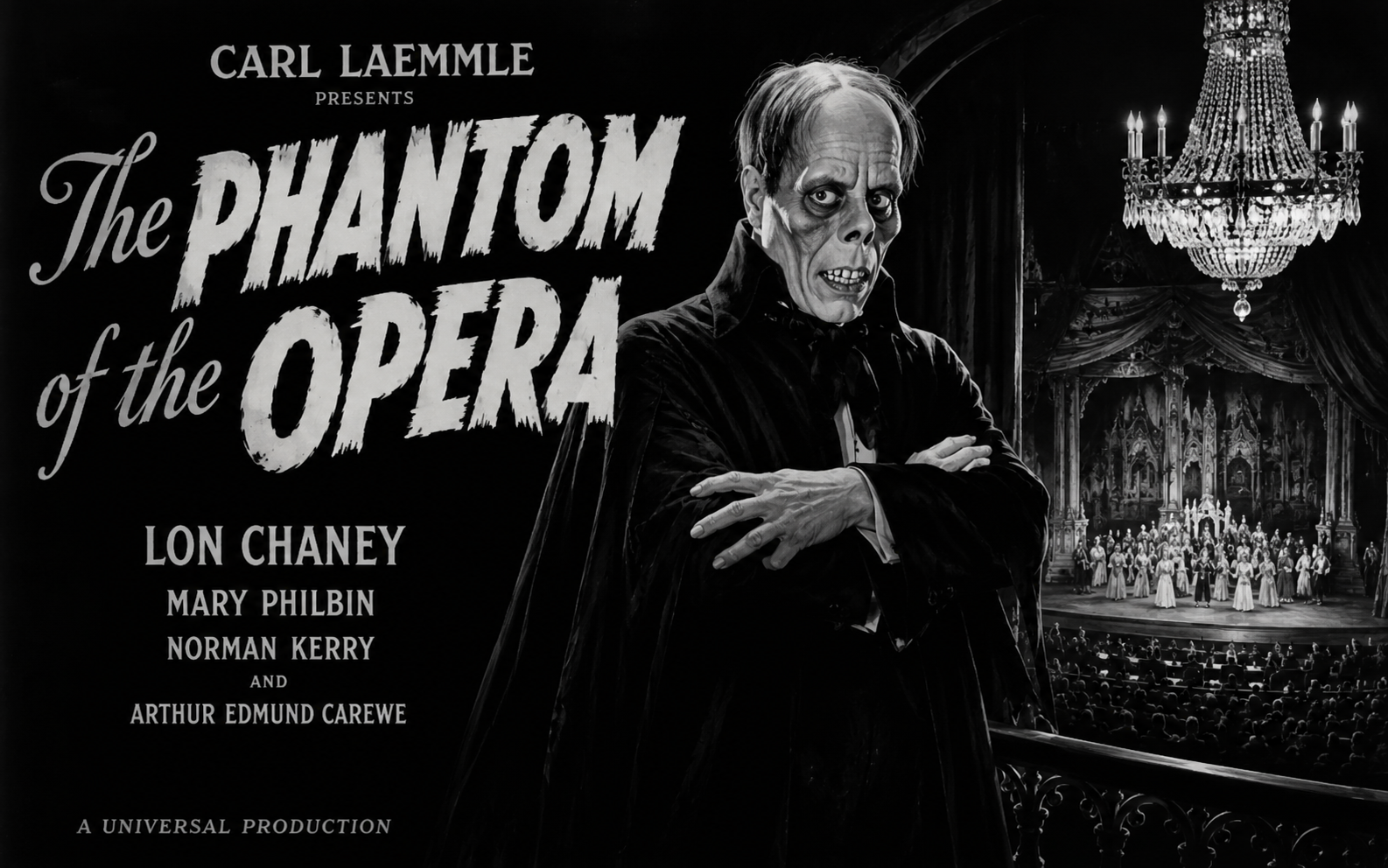
The Birth of a Cinematic Monster
When The Phantom of the Opera reached audiences in 1925, the horror film had not yet developed the familiar collection of monsters, visual conventions, and psychological patterns that would later define the genre. Universal Pictures was still years away from releasing Dracula, Frankenstein, and The Mummy, yet the foundations of that celebrated horror tradition were already being constructed beneath the enormous chandeliers and shadowed corridors of the Paris Opera House. Adapted from Gaston Leroux’s 1910 novel and directed principally by Rupert Julian, the film presented viewers with a character who was neither entirely supernatural nor comfortably human, combining the theatrical scale of Gothic melodrama with an intimate study of humiliation, desire, and violent possession. Lon Chaney’s performance as Erik, the disfigured figure haunting the opera house, became one of the defining achievements of silent cinema and helped demonstrate that a screen monster could inspire terror without surrendering all traces of emotional complexity. (LA Opera)
The film’s power begins with its setting, because the opera house represents far more than an impressive location. It is a place devoted to transformation, illusion, music, beauty, and public admiration, where performers become idealized figures beneath elaborate costumes and controlled lighting. Beneath this radiant world, however, lies a hidden architecture of cellars, tunnels, chambers, traps, and subterranean passages, creating a physical division between the beauty presented to society and the pain that society refuses to acknowledge. Erik inhabits that concealed world, and his position beneath the stage reflects his psychological condition: he possesses extraordinary musical knowledge and theatrical intelligence, yet he believes that his face excludes him permanently from the human community above.
This contrast gives the story its enduring emotional structure. The visible world celebrates beauty as though it were evidence of virtue, while the invisible world contains everything that beauty has rejected. Erik does not merely hide because he fears discovery; he has constructed an entire identity around the conviction that discovery must lead to disgust. His underground kingdom therefore becomes both a refuge and a prison, protecting him from public humiliation while preserving the bitterness that makes genuine human connection increasingly impossible.
The Opera House as a Divided Human Mind
The architecture of The Phantom of the Opera can be understood as a psychological map. The stage represents the socially acceptable self, the identity carefully arranged for public recognition, while the underground chambers represent the desires, injuries, and resentments that have been pushed beyond ordinary sight. Christine Daaé performs in the illuminated world above, where talent is transformed into applause, but her voice is being cultivated by an unseen teacher who speaks from behind walls and shadows. The beauty admired by the audience is therefore connected to a hidden source that cannot appear publicly without destroying the illusion.
This relationship between surface and depth makes the opera house feel alive. Curtains conceal movement, mirrors become entrances, rooms contain secret mechanisms, and walls cannot be trusted to remain boundaries. Every part of the building suggests that another reality exists behind what is visible, reinforcing the central anxiety that identity itself may be theatrical. People appear refined, respectable, and civilized in the public spaces, yet they remain vulnerable to ambition, vanity, deception, and fear. Erik may be the most physically concealed character, but he is not the only person wearing a mask.
The film’s enormous sets strengthened this impression by giving the drama a scale uncommon even within ambitious silent productions. The recreation of the Paris Opera House, the sweeping staircases, the auditorium, the underground lake, and the elaborate performance spaces create a world in which human beings seem small compared with the institutions they inhabit. The visual grandeur does not reduce the horror; it intensifies it by suggesting that violence can hide inside beauty without diminishing its surface magnificence. The opera continues, the costumes remain splendid, and the audience continues applauding even while terror moves through the building’s unseen foundations.
Christine and the Seduction of the Invisible Voice
Christine’s relationship with the Phantom begins not through physical attraction but through sound. Erik presents himself as the mysterious Angel of Music, cultivating her talent while remaining concealed from sight. This arrangement gives him enormous psychological influence because a voice without a visible body can become whatever the listener needs it to be. Christine can imagine wisdom, artistic authority, spiritual guidance, or transcendent devotion because she has not yet been forced to reconcile the voice with the human being who produces it.
The dynamic reveals how idealization depends upon distance. As long as Erik remains unseen, Christine can respond to his knowledge and musical power without confronting the reality of his demands. He occupies a space between teacher, supernatural presence, and romantic authority, gradually making himself central to her artistic identity. His influence becomes dangerous because he does not merely want to help her sing; he wants to become the indispensable source of her success, ensuring that her confidence, opportunity, and emotional direction remain tied to him.
This is one of the film’s deepest insights into possessive love. Erik interprets his devotion as evidence that he deserves Christine, while failing to recognize that love cannot be created through dependency, intimidation, or control. He gives her instruction, access, and artistic advancement, but every gift contains an expectation of ownership. His generosity is therefore unstable because it cannot survive her independence. The moment Christine chooses another future, his role as mentor collapses into the behavior of a captor.
The Unmasking and the Destruction of Fantasy
The most famous sequence in the film occurs when Christine approaches the Phantom from behind and removes his mask. The scene remains powerful because it is not constructed merely as the revelation of frightening makeup; it is the violent collision between imagination and reality. Until that moment, Christine has known Erik through music, authority, mystery, and fear, but the removal of the mask forces her to encounter the body he has organized his entire existence around concealing.
Lon Chaney devised his own makeup, transforming his face through practical manipulation rather than relying on the later technologies available to screen performers. His skeletal nose, enlarged nostrils, sunken eyes, and distorted mouth created an appearance that shocked contemporary audiences and became one of the most recognizable images in silent horror. Chaney’s transformation was deliberately protected from publicity before the film’s release, increasing the force of the revelation when viewers finally saw the Phantom’s face. (LA Opera)
Yet the scene’s true horror lies in Erik’s reaction to being seen. His rage does not arise only because Christine has disobeyed him; it arises because she has destroyed the controlled identity he created through the mask. While concealed, he could determine how she perceived him, presenting himself as genius, mystery, authority, and unseen protector. Once exposed, he becomes vulnerable to her spontaneous response, and the terror on her face confirms the judgment he has feared throughout his life.
The tragedy is that Erik responds to rejection by making himself more deserving of it. Rather than allowing Christine’s fear to confront him with the harm he has caused, he interprets it as proof that the world is incapable of accepting him. He therefore turns pain into justification, using humiliation as permission for domination. His face may explain his isolation, but it does not excuse his cruelty, and the film becomes more psychologically sophisticated when these two truths are allowed to coexist.
Lon Chaney and the Physical Language of Silent Horror
Lon Chaney was celebrated as the “Man of a Thousand Faces” because of his extraordinary capacity for physical transformation, but his achievement in The Phantom of the Opera extends far beyond makeup. Silent cinema required performers to communicate emotion through posture, rhythm, gesture, and the organization of the body within the frame. Chaney uses those tools to create a character whose authority can shift rapidly into vulnerability and whose elegance can become animalistic violence without losing coherence.
When the Phantom is in control, his movements carry theatrical precision. He uses his cape, mask, hands, and posture as elements of deliberate presentation, making every entrance feel staged. He understands spectacle because he lives within a theater, and he transforms himself into a performance designed to inspire obedience. His identity is not simply hidden by costume; it is manufactured through costume.
After the unmasking, however, his physical behavior changes. The controlled figure becomes exposed, contorted, and reactive, allowing the audience to see the terror beneath the terror he creates. Chaney’s performance does not invite uncomplicated sympathy, because Erik remains threatening and violent, but it prevents him from becoming emotionally empty. The viewer can understand the wound without approving what the wounded person chooses to do with it.
This distinction helped establish one of the central traditions of later Universal horror. The monster would frequently become more than an external threat; he would become a figure through whom audiences could confront loneliness, exclusion, bodily difference, forbidden desire, or the consequences of human cruelty. The British Film Institute has described Chaney’s Phantom as a foundational moment in the development of Hollywood monster cinema, where melodrama and horror merged around a grotesque but emotionally charged central figure. (BFI)
The Red Death and the Performance of Terror
Among the film’s most visually memorable sequences is the masked ball, during which the Phantom appears dressed as the Red Death. While much of the film is presented through black-and-white or tinted imagery, surviving versions famously include a two-strip Technicolor sequence that transforms the ballroom into an eruption of color, movement, and theatrical excess. Erik descends the staircase in a crimson costume, turning himself into an image of death entering a celebration that had attempted to proceed without him.
The costume reflects Erik’s understanding of psychological power. He does not simply enter the ball to deliver information or make a threat; he stages an apparition. His appearance is designed to interrupt pleasure and redirect every gaze toward him, allowing the rejected man beneath the mask to become the central figure in the room. He may believe that his real face prevents him from commanding admiration, but through performance he can command fear, and fear becomes his substitute for belonging.
This transformation reveals why Erik is inseparable from the opera house. He possesses the instincts of a director, designer, composer, illusionist, and performer, controlling entrances, lighting, sound, architecture, and suspense. His crimes are theatrical because theatricality provides the power that ordinary social life denied him. Instead of asking to be recognized, he creates conditions under which recognition becomes unavoidable.
The Red Death sequence also exposes the instability of public spectacle. The ball is designed as a celebration of luxury, costume, and collective pleasure, yet its masks make intrusion possible because identity has already become fluid. Erik enters a world where everyone is disguised, making the monster temporarily indistinguishable from the guests. The moment therefore suggests that society does not eliminate darkness through elegance; it may simply provide darkness with more beautiful clothing.
Love Transformed into Ownership
Erik’s attachment to Christine is often described as tragic love, but the film becomes more meaningful when his behavior is examined without romanticizing possession. He does not accept Christine as an independent person whose desires might differ from his own. Instead, he treats her voice, career, attention, and future as extensions of the emotional world he has constructed around her. His love is intense, but intensity alone does not make love ethical.
This distinction matters because possessive relationships frequently present control as sacrifice. Erik has devoted himself to Christine’s voice, created opportunities for her, and imagined a future in which her success validates his own hidden genius. From his perspective, these actions demonstrate devotion, yet they also create an internal account in which he believes she owes him loyalty. When Christine does not repay his investment with submission, he experiences her freedom as betrayal.
The film therefore captures the psychological danger of confusing need with entitlement. Erik’s loneliness is real, his exclusion is painful, and his longing for affection is understandable, but none of those experiences grant him ownership over another human being. His tragedy does not consist only in being denied love because of his appearance; it also consists in becoming so consumed by the fear of rejection that he destroys the conditions under which love might have become possible.
Christine’s resistance represents more than a preference between two romantic figures. She must separate artistic awakening from emotional captivity, recognizing that the person who encouraged her talent also seeks to control the life that talent has opened. Her escape is therefore a recovery of agency, a refusal to allow gratitude, fear, or pity to become permanent obligations.
The Monster Created by the Gaze
The Phantom’s face has often been treated as the source of his monstrosity, yet the film continually complicates that assumption. Erik’s appearance provokes fear, but his choices create danger. This difference prevents the story from reducing physical difference to moral corruption, even though the imagery inevitably reflects the attitudes of its era. The most disturbing dimension of the character is not that he looks frightening; it is that he has allowed the world’s response to his appearance to become the organizing principle of his identity.
A person who expects rejection may attempt to avoid all situations in which rejection is possible, but Erik goes further by controlling others before they can judge him freely. He hides, manipulates, threatens, and stages terror because domination protects him from uncertainty. If Christine remains with him through force, he never has to discover whether she could have chosen him voluntarily. The prison he creates for her therefore protects him from the emotional risk that authentic love requires.
This is why the mask carries such powerful symbolism. It conceals the face, but it also preserves the story Erik tells himself about that face. Beneath the mask, he can believe that appearance alone explains his isolation, allowing him to avoid examining how secrecy, rage, violence, and entitlement have deepened it. The mask does not simply hide his wounds from society; it hides his responsibility from himself.
The film’s psychological horror emerges from this feedback loop. Shame produces concealment, concealment produces distorted relationships, distorted relationships produce rejection, and rejection intensifies shame. Unless that cycle is interrupted through self-recognition, every attempt to escape loneliness creates more of it. Erik’s underground world becomes the physical expression of a mind trapped inside that cycle.
Music, Silence, and Emotional Authority
Although The Phantom of the Opera is a silent film, music remains central to its world. The story revolves around singers, composers, performances, and the emotional authority of sound, creating a fascinating paradox in which the audience sees music’s effects without hearing a permanently fixed original soundtrack. Silent films were typically accompanied by live musicians, organs, orchestras, or specially prepared scores, meaning that the emotional experience of the film could change from one exhibition to another.
This variability suits the Phantom’s elusive identity. Erik exists through voice before he exists through image, and the film itself depends upon music that may come from sources beyond the screen. The theater audience and Christine are both influenced by invisible sound, blurring the boundary between the Phantom’s world and the conditions under which the movie is being watched.
Modern screenings with live orchestral or organ accompaniment continue to demonstrate how strongly the film was designed around musical rhythm and architectural spectacle. Institutions still present the movie as a major performance event, confirming that it functions not merely as an old film preserved for historical interest but as a work capable of generating a living relationship between image, music, space, and audience. (LA Opera)
The absence of recorded dialogue also intensifies the importance of the face. Every expression becomes a statement, making the Phantom’s concealed appearance even more significant. Christine’s fear, Erik’s rage, Raoul’s determination, and the crowd’s panic must all be communicated visually, placing the human face at the center of a story about a man who believes his own face has condemned him.
The Crowd and the Collapse of the Phantom’s Kingdom
The film’s final movement shifts the Phantom from hidden ruler to hunted fugitive. For much of the story, Erik controls the opera house because he understands its secret architecture better than anyone else. He can appear, disappear, trap intruders, manipulate performances, and move between worlds. His power depends upon asymmetry: he knows where everyone is, while no one knows where he is.
Once the crowd pursues him into the streets, that advantage disappears. The secretive individual is exposed to collective judgment, and the man who once controlled every entrance becomes the object of a public chase. His death does not arrive through meaningful reconciliation or personal understanding; it comes through the force of a mob that overwhelms him and throws his body into the river.
The ending offers a grim reversal rather than moral healing. Erik’s violence has made him dangerous, yet the crowd does not defeat him through justice in any careful sense. It responds with its own collective violence, turning the rejected outsider into a spectacle of punishment. The Phantom is destroyed, but the social appetite for fear, humiliation, and aggression remains visible.
This ambiguity prevents the conclusion from becoming reassuring. The monster’s death restores order to the story, but it does not resolve the conditions that helped create him. The world above may continue operating, the performances may resume, and the opera house may appear safe again, yet the divisions between appearance and truth, beauty and rejection, public refinement and hidden cruelty remain untouched.
Why the Film Still Haunts Audiences
A century after its release, The Phantom of the Opera remains influential because it understands that horror does not require an entirely inhuman monster. Erik is frightening precisely because his most destructive impulses grow from recognizable emotions: shame, loneliness, longing, jealousy, humiliation, and the desire to control how others see him. The film enlarges those emotions through Gothic spectacle, but it never removes their human origin.
Its imagery also helped shape the visual identity of cinematic horror. The unmasking, the underground lake, the opera house shadows, the Red Death costume, the chandelier, and Chaney’s skeletal face became part of the language through which later filmmakers represented hidden monstrosity. The film demonstrated that horror could be beautiful, theatrical, tragic, and grotesque at the same time, helping prepare audiences for the cycle of Universal monster films that followed. (BFI)
The Phantom himself survives because he cannot be reduced to a single interpretation. He can be seen as a victim who becomes a victimizer, an artist corrupted by isolation, a rejected man who confuses love with ownership, or a performer who discovers that terror guarantees the attention affection cannot provide. Each interpretation deepens the others, creating a character whose horror arises not from one deformity but from the psychological world constructed around it.
The Face Beneath the Mask
The enduring lesson of The Phantom of the Opera is not that the hidden face must eventually be exposed, but that concealment changes both the person who hides and the relationships he attempts to create. Erik believes the mask protects him from cruelty, yet it also permits him to avoid vulnerability, mutuality, and accountability. Behind it, he can become whatever others fear or idealize, but he cannot be known.
Christine’s removal of the mask is therefore the story’s decisive psychological act. She does not merely reveal a face; she destroys a system of control built upon invisibility. Once Erik is seen, he must confront the difference between the magnificent identity he performs and the wounded human being beneath it. His inability to tolerate that confrontation turns revelation into catastrophe.
The film remains haunting because everyone constructs some form of mask, even when the disguise is less visible than Erik’s. People curate the qualities they want admired, conceal the wounds they fear will produce rejection, and sometimes attempt to control relationships so those hidden injuries are never tested. The Phantom of the Opera takes that universal impulse to its darkest conclusion, showing how the fear of being seen can become more destructive than the judgment one originally feared.
Nearly one hundred years after Lon Chaney first emerged from the shadows of the opera house, his Phantom still commands attention because he embodies a disturbing contradiction. He wants desperately to be loved, yet he cannot permit another person the freedom upon which love depends. He hides because he fears rejection, yet his hiding transforms fear into obsession and obsession into violence. The mask makes him mysterious, but the tragedy beneath it is painfully recognizable: a person may spend so long protecting himself from being wounded that the protection itself becomes the force that destroys him.
