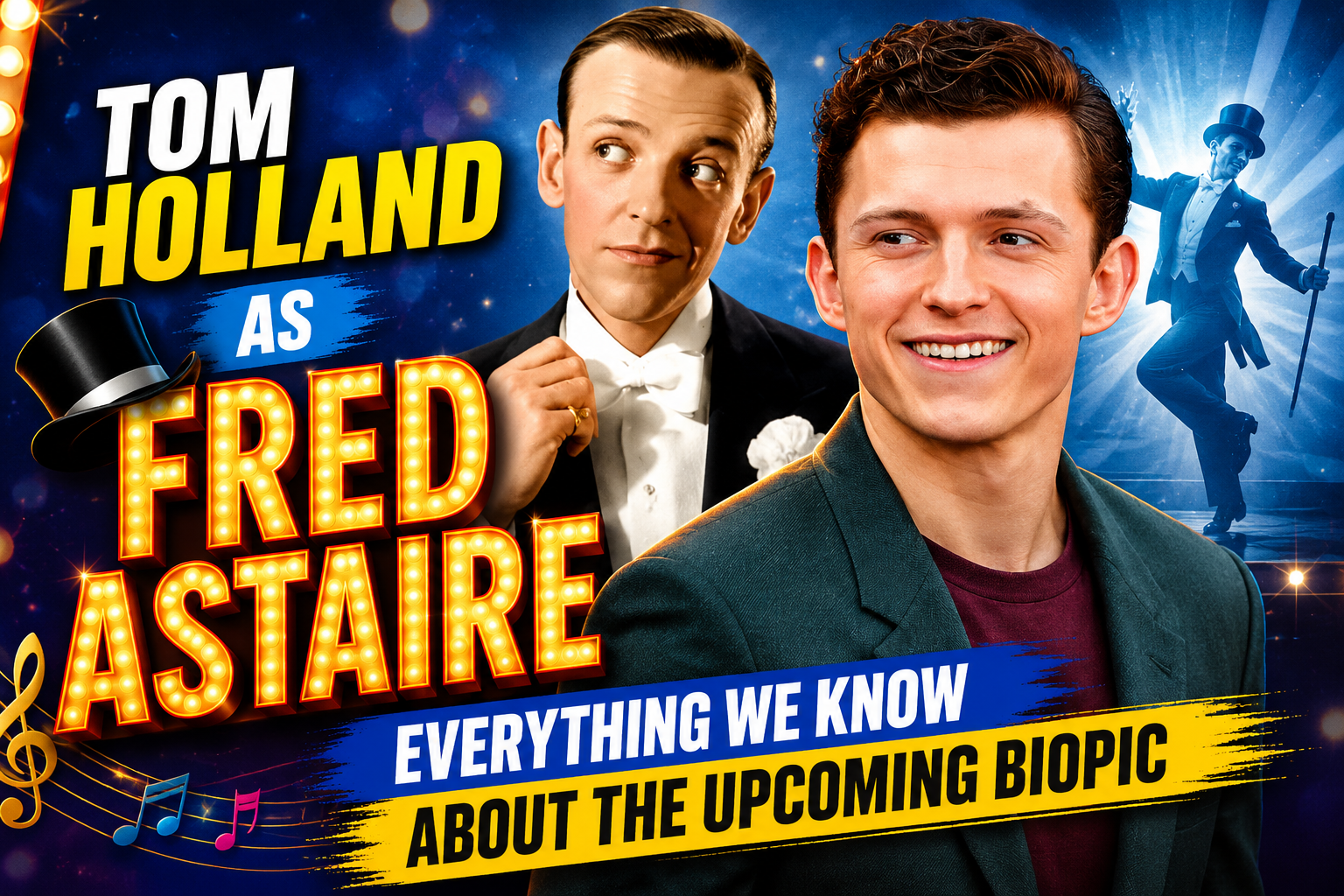
For almost five years, Tom Holland’s Fred Astaire biopic existed in the frustrating territory occupied by many ambitious Hollywood projects: announced, discussed, attached to major talent, but never quite close enough to production to feel inevitable. That changed significantly in July 2026. Holland confirmed that the long-planned film is intended to be his next project, revealed that he has already begun dance rehearsals, and described his first sessions as producing a mixture of excitement and “absolute dread” because of the amount of work required to portray Astaire convincingly. More importantly, he has begun articulating an artistic ambition for the film that goes considerably beyond physical resemblance. Holland wants to perform the dancing himself, without doubles, and hopes the dances can be photographed in sustained takes that reflect Astaire’s own approach to presenting movement on screen. The project is therefore beginning to reveal not merely who will play Fred Astaire, but what kind of Fred Astaire film its star wants to make. (TheWrap)
For audiences who discover Astaire through Holland, however, the forthcoming biopic will inevitably be an interpretation rather than an introduction to the complete artist, which makes this an ideal moment to return to the performances that created the legend in the first place. You can watch Fred Astaire’s original classic movies and explore other films from Hollywood’s golden age at https://www.empoweringentertainmentpublishing.com/classic-movies. Seeing Astaire himself before seeing another actor portray him immediately clarifies the scale of Holland’s challenge, because Astaire’s apparent simplicity concealed an extraordinary combination of musicality, technical discipline, acting, partnership and cinematic intelligence. The question facing the production is therefore much larger than whether Holland can learn difficult choreography. It is whether a contemporary film can make us understand why Fred Astaire made difficult choreography look as though difficulty had ceased to exist.
The Fred Astaire Biopic Is Finally Moving Forward
The project was originally announced in 2021, when Holland revealed that producer Amy Pascal had approached him about portraying Astaire. In the years that followed, the film remained in development while Holland moved through major commitments and the creative team evolved, creating understandable uncertainty about whether the biopic would actually reach production. The clearest change arrived during Holland’s July 2026 promotional appearances, when he described the Astaire film as what he is planning to do next and confirmed that dance preparation has already started. Current reporting points toward a planned January 2027 production start, although that remains a target rather than a guarantee and, as of August 2026, no official release date has been announced. (The Independent)
That distinction matters because Hollywood development announcements are easy to mistake for production certainty. Holland’s comments now carry greater weight precisely because rehearsal has begun and because he is discussing the project in practical rather than hypothetical terms. He is no longer merely attached to the idea of playing Astaire; he is confronting the physical requirements of doing so. The film still has significant stages to pass through before audiences see it, but the transition from years of development into active dance preparation makes the project substantially more concrete than it has been at any earlier point.
Tom Holland Has Already Started Training
Holland’s first rehearsals may be the most important recent development because Fred Astaire is not a role that can be constructed primarily through costume, makeup, accent and conventional character research. Astaire’s body was inseparable from his identity. The way he transferred weight, held his upper body, interacted with music and moved toward or away from a partner communicated character before dialogue was required. An actor portraying him therefore has to develop enough physical credibility that dancing does not appear to be an additional skill the character suddenly acquires whenever a musical sequence begins.
Holland enters that process with an unusually relevant background. Long before Spider-Man made his athleticism globally recognizable, he trained as a dancer and performed the title role in Billy Elliot the Musical in London’s West End. The Astaire film therefore represents a return to an artistic discipline that was central to his childhood career rather than the acquisition of an entirely unfamiliar skill. Yet Holland has been candid about the distance between possessing that foundation and being ready to portray Astaire, acknowledging after his early rehearsals that the magnitude of the work ahead became immediately apparent. (TheWrap)
That awareness may be encouraging because Astaire is precisely the kind of performer whose work becomes more intimidating as one studies it closely. The visible steps constitute only one layer. Beneath them lies the ability to maintain extraordinary precision while allowing the upper body and face to remain relaxed enough for acting to continue. Holland can learn choreography relatively quickly because of his background, but reproducing Astaire’s illusion of effortlessness requires the choreography to become so deeply internalized that the audience stops seeing an actor concentrating on executing it.
Holland Wants to Dance Without Doubles
Holland has now made one particularly ambitious intention explicit: he wants to perform the dancing himself rather than rely upon doubles. That decision is more important for a Fred Astaire film than it would be for many musical biopics because physical authorship was fundamental to Astaire’s screen identity. Audiences were not simply watching a character who happened to be presented as an extraordinary dancer; they were watching the star himself complete the choreography, often with enough bodily visibility and continuity for the achievement to be unmistakable. (TheWrap)
Contemporary filmmaking could disguise a dance double with remarkable sophistication, and there would be nothing inherently illegitimate about using one if necessary. Yet the contradiction would be difficult to ignore in a film about Astaire. Replacing Holland’s body during the most demanding choreography would mean constructing an image of the very quality Astaire’s filmmaking philosophy attempted to prove physically. Holland’s desire to avoid that problem suggests he understands that authenticity in this particular role cannot be reduced to looking like Astaire when standing still.
The commitment also raises the stakes considerably. If Holland performs the dances himself and the film allows audiences to see enough of his body to verify that fact, comparison with Astaire becomes unavoidable. His technique does not need to equal a man who spent virtually his entire life dancing, but it must become convincing enough that the audience stops wondering whether he can complete the choreography and begins paying attention to what the character is communicating through it.
He Wants the Dances Shot in One Take
Holland’s second stated ambition may be even more consequential: he wants to shoot the dances in single takes, explicitly connecting that desire to Astaire’s own approach. This does not necessarily mean the finished film will photograph every musical sequence as one uninterrupted shot, because those decisions will ultimately involve the director, choreographers, cinematographer, editors and the practical realities of production. Nevertheless, Holland’s aspiration reveals that he understands something fundamental about the cinematic problem the film faces. (The Independent)
Editing can create rhythm, conceal weaknesses and combine the strongest portions of multiple performances into an apparently continuous achievement. Astaire’s greatest numbers frequently derive their authority from another kind of relationship with the viewer: the camera gives the performer enough time and space to establish that the movement itself contains the rhythm. The audience can perceive the complete body, understand where it exists in relation to a partner and recognize the continuity of the physical accomplishment. What appears elegant is therefore also credible.
For Holland, sustained takes would create enormous pressure because technical competence alone would not be enough. A dancer can execute two minutes of difficult choreography correctly and still reveal concentration through the shoulders, face, breathing or transitions. Astaire’s extraordinary achievement was to make the audience forget that execution was occurring. If Holland truly intends to expose himself to longer takes without a double, his preparation must eventually move beyond remembering steps and toward the much more difficult task of making them appear inevitable.
Paul King Is Directing
Paul King remains attached to direct the untitled project, an intriguing choice because his work on Paddington, Paddington 2 and Wonka has demonstrated a particular affinity for visually elaborate worlds that retain emotional warmth rather than allowing production design to overwhelm character. Current reporting continues to identify King as the director as the project moves toward its intended production period. (Cinema Group)
King’s challenge will be unusually delicate because a Fred Astaire film cannot simply reproduce the visual grammar of the 1930s and 1940s as an exercise in nostalgic imitation, but neither can it embrace contemporary filmmaking habits so aggressively that Astaire’s philosophy disappears. The camera needs to feel modern without becoming impatient with the human body. Visual sophistication can surround the choreography, but if editing and camera movement continually manufacture excitement that Holland and his partners should be generating themselves, the film may celebrate Astaire while contradicting him stylistically.
This is where King could become as important to the success of the portrayal as Holland’s dance preparation. The most convincing tribute to Astaire would not necessarily imitate his movies shot for shot. It would understand why he wanted the audience to see what the dancer was doing and then find a contemporary cinematic language capable of preserving that trust.
The Screenplay Has Evolved During Development
One area where reporting has become less straightforward is the screenplay. Recent coverage accompanying Holland’s July 2026 comments identifies Steven Levenson as screenwriter, while other current industry listings and reports continue to associate Lee Hall with the project; IMDb presently lists Lee Hall and Micah Schraft. The safest conclusion is therefore that the screenplay has passed through different writers or drafts during its extended development rather than treating any older writing credit as necessarily definitive for the film that ultimately reaches production. (People.com)
That evolution would hardly be surprising for a project that has been developing since 2021, but the eventual screenplay will carry an unusually heavy responsibility. Astaire’s life cannot simply be converted into a chronological procession of famous performances because the artistic evolution between those performances is where much of the real story lies. His childhood partnership with his sister Adele, the loss of that partnership when she retired, his transition into Hollywood, the extraordinary cultural phenomenon created with Ginger Rogers and his later reinventions with performers including Rita Hayworth, Judy Garland, Cyd Charisse and Audrey Hepburn provide enough material for several films.
The central question is therefore one of selection. A biopic becomes meaningful not by including everything that happened but by identifying the underlying conflict that makes those events belong to the same story. For Astaire, the tension between obsessive preparation and effortless presentation could provide exactly such a spine: a man who worked relentlessly so audiences would never see him working.
What Will the Film Actually Cover?
Despite years of discussion, detailed official plot information remains limited. That absence is important because it means speculation about precisely which periods, relationships or famous films will appear should not be confused with confirmed information. The eventual scope will determine whether Holland is portraying Astaire principally during his emergence as a Hollywood star, across the legendary Ginger Rogers years, or over a much broader period of his life and career.
A wide chronological approach would offer enormous rewards but equally significant problems. Astaire’s evolution is fascinating precisely because the performer in Top Hat is not identical to the mature artist of The Band Wagon nearly two decades later. Showing that development would allow the film to examine longevity, changing partnerships and the challenge of aging inside an art form strongly associated with physical ability. Yet compressing too many decades could reduce precisely those transformations to a series of recognizable moments.
A more concentrated story could go deeper psychologically, particularly if Adele Astaire and Ginger Rogers become the two partnerships through which the film examines Fred’s evolving identity. Adele belonged to the artistic foundation from which he emerged, while Rogers became central to the screen mythology that transformed him into an international icon. The transition between those partnerships alone contains enough material to explore loss, reinvention, collaboration and the complicated relationship between individual genius and the people who help make it visible.
Who Will Play Ginger Rogers?
As of August 2026, no official casting announcement for Ginger Rogers has emerged in the reliable current reporting surrounding Holland’s latest update, and broader supporting-cast details remain largely unannounced. BroadwayWorld’s July report specifically noted that further cast details had yet to be revealed. (BroadwayWorld)
Whoever eventually plays Rogers will carry a responsibility almost as complicated as Holland’s because the role cannot function merely as a romantic counterpart to a famous man. Rogers was essential to the construction of Astaire’s screen identity, and their chemistry depended upon the fact that she brought a distinct comic, dramatic and physical personality into the partnership. If the actress is treated primarily as someone for Holland to dance around, the film will misunderstand the very relationship it is attempting to recreate.
The casting announcement may therefore tell us something significant about the project’s intentions. A genuinely formidable actress with enough physical preparation to share the frame rather than disappear inside it would suggest that the filmmakers understand Astaire’s greatness as collaborative. The stronger Ginger Rogers is allowed to become, the more interesting Fred Astaire can become in response.
Why Holland May Be Better Casting Than It Initially Appeared
When Holland’s casting was first announced, the most obvious connection was physical: a young actor famous for athleticism who happened to possess serious childhood dance training. Five years later, the casting looks potentially more interesting because Holland’s career has evolved enough for the role to represent a genuine departure rather than simply another demonstration of agility.
Astaire requires a different form of masculine screen presence from the one associated with superhero cinema. Power is communicated through precision rather than force, confidence through restraint rather than physical domination, and romantic authority through responsiveness to a partner rather than conquest. Holland must therefore transform not simply his technique but the meaning audiences associate with his body.
That challenge could produce a more interesting performance than straightforward resemblance ever would. The best biographical casting does not necessarily begin with an actor who already appears identical to the subject; it creates enough tension between actor and subject that transformation becomes artistically meaningful. Holland has the physical foundation to make the attempt plausible while remaining different enough from Astaire that the process cannot be taken for granted.
There Is Still a Great Deal We Do Not Know
The increased momentum surrounding the project should not obscure how much remains unconfirmed. There is still no announced theatrical release date, the broader cast has not been formally revealed, detailed plot information remains scarce, and even the planned January 2027 production start should be understood as the current intention rather than an immutable schedule. Holland’s comments make the film substantially more tangible than it was a year ago, but they do not eliminate the uncertainty inherent in a production still preparing to shoot. (BroadwayWorld)
What has changed is that we can finally begin evaluating the project through its artistic ambitions rather than through casting announcements alone. Holland wants to dance himself. He wants to avoid doubles. He wants sustained takes. He has begun rehearsing and discovered that his existing dance background does not make the challenge remotely easy. Those facts create the first meaningful outline of how he intends to approach Astaire.
The unanswered questions may now be the most interesting ones. How will Paul King photograph the dances? Who will play Ginger Rogers? How much of Astaire’s life will the screenplay attempt to cover? Will Adele Astaire occupy a substantial place in the story? Which famous numbers, if any, will be recreated? Will the film show the labor behind Astaire’s perfection or concentrate primarily upon the finished public image? Each answer will reveal whether the production understands Fred Astaire as a recognizable icon or as an artist whose entire philosophy of performance deserves examination.
Tom Holland portraying Fred Astaire is therefore no longer interesting merely because one famous actor is transforming into another famous performer. The project is becoming a test of whether contemporary Hollywood can make physical mastery compelling without hiding it beneath the tools contemporary cinema normally uses to intensify spectacle. Holland has publicly set himself an unusually demanding standard, and that standard raises fascinating questions about everything from his training and the casting of Ginger Rogers to Paul King’s visual approach and the decision to let the camera remain on a dancer long enough for the audience to judge the performance for itself. Continue reading to discover why Holland’s Billy Elliot past may matter more than his Spider-Man athleticism, what Astaire’s famous approach to filming dance will demand from the production, why the actress playing Ginger Rogers could determine whether Holland’s performance truly works, and what the biopic must avoid if it wants to capture the man rather than merely reproduce the icon. Become an Empowering Entertainment Magazine subscriber to unlock the complete feature and follow the deeper story of one of the most ambitious transformations currently taking shape in Hollywood.

Unlock the Entire Empowering Entertainment Library
This article is only the beginning.
Become a member and enjoy unlimited access to every premium magazine article, expert interviews, in-depth features, practical guides, and a growing digital library of hundreds of books covering business, entrepreneurship, film production, personal growth, health, relationships, AI, ADHD, and much more.
One membership. Hundreds of resources. New content added every week.