

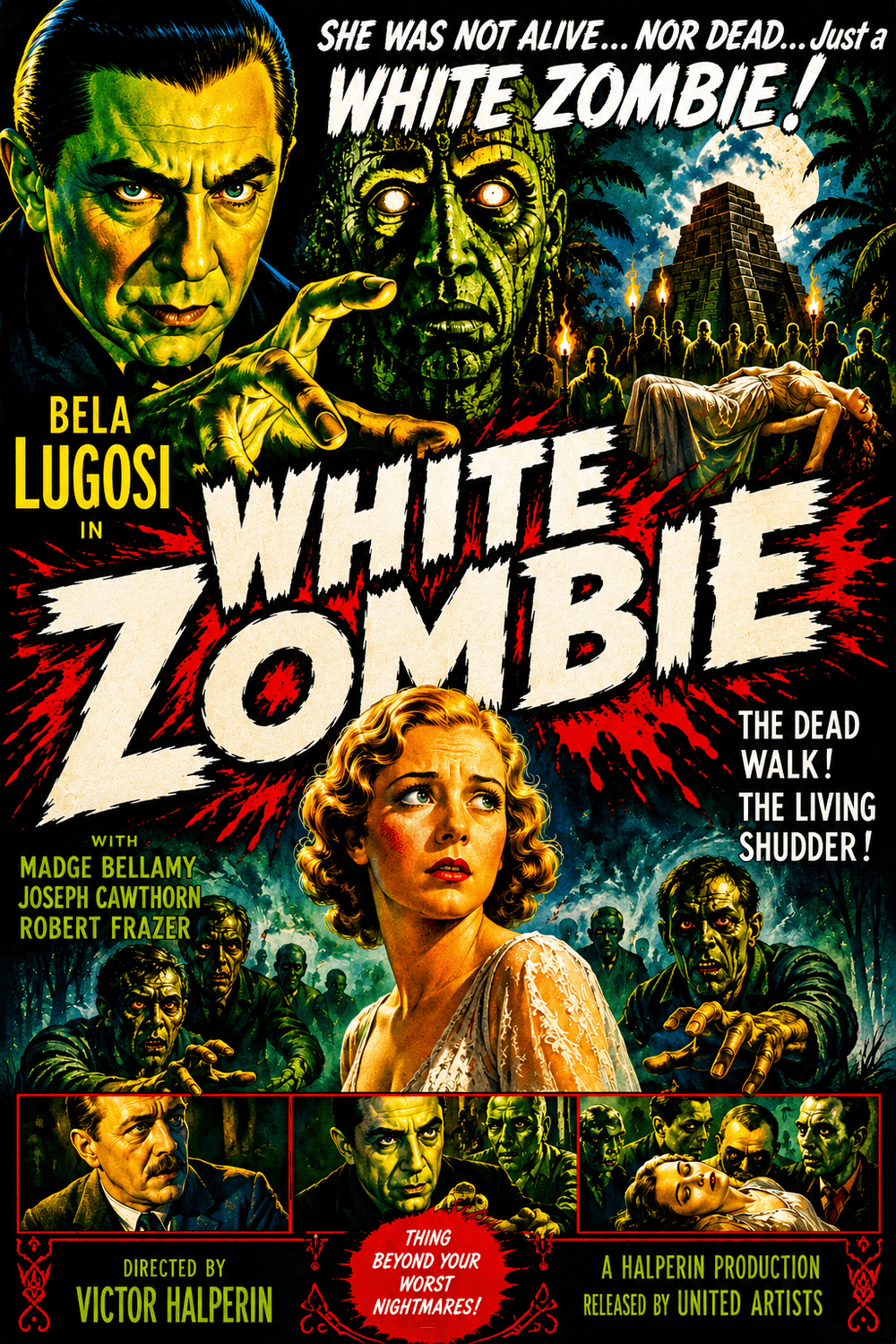
Before Zombies Became the Living Dead
When White Zombie appeared in 1932, the zombie had not yet become the decaying, flesh-eating creature that modern audiences immediately recognize. There were no apocalyptic hordes overwhelming cities, no infection spreading through bites, and no collapsing civilization filled with survivors struggling against the undead. Instead, the film presented a more intimate and psychologically disturbing form of horror in which the body remained alive while the will had been removed, leaving behind a human being capable of movement and obedience but no longer capable of choosing, resisting, or expressing an independent identity. Directed by Victor Halperin, produced independently by his brother Edward Halperin, and starring Bela Lugosi as the sinister Murder Legendre, White Zombie is widely regarded as the first feature-length zombie film and became the cinematic foundation from which one of horror’s most durable monsters would eventually evolve. The American Film Institute records its 1932 release, Victor Halperin’s direction, and Lugosi’s central role, while Turner Classic Movies identifies it as the first Hollywood production built around zombies and notes its connection to William B. Seabrook’s 1929 book The Magic Island. (AFI Catalog)
The difference between these early zombies and the creatures later popularized by George A. Romero is essential to understanding the film’s particular kind of terror. Romero’s zombies threaten to destroy the body through consumption, but the zombies of White Zombie threaten something even more fundamental: the possibility that the body may continue functioning after the self has disappeared. They do not pursue victims because they are hungry, nor do they multiply through contamination. They exist as controlled laborers and obedient instruments whose personalities have been erased, transforming the zombie from a symbol of death into a symbol of domination.
This earlier conception of zombification creates a horror rooted not in physical destruction alone but in the theft of agency. Death is frightening because it ends consciousness, yet the fate imagined by White Zombie is in some ways more disturbing because consciousness appears to have been suspended while the body remains available for another person’s use. The victim can be seen, touched, commanded, and displayed, but cannot meaningfully answer. The human form survives while the human will has been imprisoned, converting the familiar body into evidence of an invisible violation.
A Marriage Interrupted by Possession
The story follows Madeleine Short and Neil Parker, a young couple who travel to Haiti intending to marry on the estate of Charles Beaumont, a wealthy plantation owner who has presented himself as their generous host. Beneath this hospitality, however, Beaumont has developed an obsessive desire for Madeleine and cannot accept that she has freely chosen another man. Rather than confronting the emotional reality of rejection, he seeks the assistance of Murder Legendre, a mysterious mill owner and practitioner of supernatural control who commands a group of zombified workers.
Beaumont’s decision establishes the central moral structure of the film because the catastrophe does not begin with an accidental curse or an uncontrollable supernatural force. It begins with a man who refuses to accept another person’s autonomy. Madeleine’s wishes are clear, yet Beaumont experiences them not as a boundary to be respected but as an obstacle to be removed. His desire may initially resemble romantic longing, but the moment he chooses coercion over consent, affection becomes indistinguishable from possession.
Legendre offers Beaumont the illusion that he can acquire Madeleine without confronting her refusal. Through a potion and supernatural manipulation, she can be separated from her fiancé, declared dead, and returned in a state of obedient passivity. Beaumont imagines that this transformation will preserve the woman he desires while eliminating the freedom that prevents her from belonging to him. What he fails to understand is that her freedom is not an inconvenient addition to her identity; it is the foundation of that identity. Once her will has been removed, the person he claims to love no longer exists in any meaningful relational sense.
The film therefore exposes the contradiction at the heart of possessive desire. Beaumont wants Madeleine because she is beautiful, alive, and emotionally significant to him, yet he is willing to destroy the very consciousness that makes reciprocal love possible. He does not truly seek her affection because affection must be freely given. He seeks the appearance of intimacy without the uncertainty of another person’s choice, reducing love to proximity, visibility, and control.
Murder Legendre and the Architecture of Control
Bela Lugosi’s Murder Legendre is one of early horror cinema’s most compelling figures because his power rarely depends upon physical violence. Legendre dominates through gaze, gesture, suggestion, and the quiet confidence of a man who understands how easily fear and desire can be converted into obedience. His sharply defined eyebrows, intense eyes, formal clothing, and deliberate movements create a character who appears to exercise control before he has visibly done anything at all.
Lugosi had already become internationally associated with horror through his performance in Dracula the previous year, and White Zombie uses many of the qualities that made that performance so influential. His voice carries ceremonial authority, his stillness makes other characters appear nervous by comparison, and his gaze creates the impression that resistance has already been anticipated. The American Film Institute identifies Lugosi’s role as Murder Legendre among the actor’s important early-1930s horror performances, placing the film within the period when his screen identity was becoming inseparable from hypnotic and supernatural authority. (AFI Catalog)
Yet Legendre differs from Dracula in a crucial respect. Dracula requires victims because he must consume life, while Legendre accumulates servants because he wants power. His zombies are not companions, converts, or extensions of a biological hunger; they are tools. Their individuality has no value to him except insofar as each body can perform a useful function, making his supernatural practices resemble an extreme form of industrial management.
This becomes unmistakable in the sugar mill, where zombified workers operate heavy machinery in a state of mechanical obedience. They move without conversation, hesitation, fatigue, or concern for one another, forming a labor system in which efficiency has been achieved through the elimination of humanity. The image is disturbing not merely because the workers appear dead, but because the system functions precisely because they no longer possess the capacity to refuse.
The Sugar Mill and the Horror of Human Machinery
The sugar mill is one of the film’s most important locations because it transforms zombification from a private supernatural crime into a social and economic structure. Legendre does not maintain his power only to satisfy personal vanity. He uses controlled bodies to produce wealth, demonstrating that the theft of human agency can be made profitable when individuals are reduced to instruments.
The machinery dominates the workers visually and rhythmically. Enormous gears turn while bodies repeat their assigned movements, creating an environment in which the distinction between person and mechanism begins to disappear. The zombies do not operate the factory as workers in the ordinary sense because work ordinarily contains some relationship between effort, intention, need, and reward. These bodies receive no reward and exercise no intention. They have become moving components inside a system designed entirely for another man’s benefit.
The sequence acquires additional historical weight because it is set within a colonial plantation environment where race, labor, land, and power are inseparable. The film’s representations of Haiti and Haitian spiritual traditions are heavily shaped by the prejudices, exoticism, and cultural distortions of early Hollywood. Modern viewers cannot responsibly discuss the movie’s importance without acknowledging that it treats Haiti largely as a mysterious backdrop for white characters’ fears while transforming Vodou into a simplified source of supernatural menace. Contemporary assessments of the film’s legacy frequently note both its foundational place in zombie cinema and its offensive or distorted treatment of Haitian culture. (Time)
At the same time, the mill unintentionally creates a powerful image of exploitation. The horror does not come from workers rebelling against authority but from workers who have lost the ability to rebel at all. Legendre has achieved what every oppressive system ultimately desires: labor without resistance, bodies without claims, and productivity without moral responsibility. The zombies are terrifying because they reveal the endpoint of a world in which human beings are valued only for what can be extracted from them.
Madeleine as the Film’s Most Disturbing Victim
Madeleine’s transformation is emotionally different from that of Legendre’s workers because the audience has seen her as a speaking, choosing, loving individual before her will is taken from her. Her zombification is therefore experienced not as the introduction of a monster but as the disappearance of a person. She remains physically recognizable, yet her gaze becomes vacant, her movements become slow and ceremonial, and her emotional responsiveness appears to have been sealed behind an inaccessible surface.
This creates a form of horror built upon absence. Madeleine does not become violently aggressive, physically grotesque, or visibly decayed. She becomes quiet. Her body is present, but everything that previously made communication possible has vanished, leaving the people around her to confront the terrifying difference between biological presence and psychological life.
Madge Bellamy’s performance relies upon restraint because the character’s loss of agency must be communicated through reduced expression rather than dramatic action. Her stillness makes her appear both beautiful and unreachable, which intensifies the moral ugliness of Beaumont’s desire. He has obtained the visual object he wanted, but the stillness that guarantees her obedience also guarantees his loneliness.
This contradiction eventually forces Beaumont to recognize the true nature of his choice. Madeleine cannot love him because the power he used to possess her removed the capacity through which love could have been offered. Her obedience gives him no emotional confirmation, her presence gives him no companionship, and her beauty gives him no reciprocal recognition. He wanted a woman who could not reject him, but he discovers that a person incapable of rejection is also incapable of acceptance.
The Empty Victory of the Possessive Man
Beaumont’s moral collapse is psychologically revealing because he initially imagines himself as a romantic sufferer rather than an aggressor. He believes his desire gives him a special claim upon Madeleine, and Legendre’s intervention allows him to preserve the fantasy that he is merely pursuing love through unconventional means. Yet the consequences of his decision gradually expose what his desire has become.
Once Madeleine stands before him without emotional response, Beaumont begins to understand that possession cannot satisfy the need for connection. The body he wanted is present, but the consciousness whose recognition he desired is absent. His supposed victory therefore becomes a form of punishment, forcing him to live beside the evidence that he destroyed the very relationship he hoped to obtain.
The film’s treatment of Beaumont is more complex than a simple portrait of villainy because guilt eventually enters his consciousness. He is horrified by Madeleine’s condition and asks Legendre to restore her, demonstrating that he retains some capacity to recognize the moral consequences of his actions. Yet this recognition does not erase his responsibility because remorse arrives only after coercion has failed to produce the emotional reward he expected.
His repentance is therefore compromised by self-interest. He wants Madeleine restored partly because he now sees her suffering, but also because her zombified state has made his fantasy unbearable. The distinction matters because genuine moral awakening requires more than regret over an unsatisfying result. It requires recognition that the original desire to control another person was itself corrupt, regardless of whether the control ultimately brought happiness.
Legendre’s True Objective
Legendre’s alliance with Beaumont is never equal because he understands from the beginning that a man driven by forbidden desire can be easily manipulated. Beaumont believes he is hiring a supernatural expert, but he is actually entering a system in which every request increases Legendre’s power. The zombification of Madeleine is not the completion of a transaction; it is the creation of another dependency.
Legendre’s method is parasitic because he does not need to invent the weaknesses of his victims. He waits for greed, jealousy, fear, or desperation to create an opening, then offers control as the solution. His supernatural authority works in partnership with ordinary human weakness, suggesting that evil rarely needs to manufacture desire when it can simply redirect what people already want.
Once Beaumont attempts to resist him, Legendre reveals that he has never regarded him as a partner. He begins transforming Beaumont into another zombie, demonstrating that anyone who relies upon domination eventually becomes vulnerable to the stronger dominator. Beaumont sought power over Madeleine and therefore placed himself beneath a man whose understanding of control was far more complete.
This reversal deepens the film’s moral logic. The person who wishes to remove another’s freedom enters a world where freedom itself has no protected value. Beaumont cannot claim the right to remain autonomous after treating Madeleine’s autonomy as disposable. By accepting Legendre’s principle that human will can be legitimately stolen, he has accepted a principle that can eventually be used against him.
The Zombie Before the Apocalypse
Modern zombie cinema often imagines the undead as a collective force escaping all control. The creatures spread because no institution can contain them, and horror emerges from the breakdown of social order. White Zombie presents the opposite structure. Its zombies are frightening because they remain completely controlled, and social order becomes monstrous because it functions too efficiently.
This distinction reveals two different historical anxieties. The modern zombie reflects fear of contagion, mass society, ecological collapse, consumerism, political failure, and the uncontrollable crowd. The early zombie reflects fear of enslavement, hypnotic influence, colonial violence, forced labor, and the loss of individual will. One monster represents chaos, while the other represents absolute order imposed by a master.
The zombies in White Zombie do not attack because they hate, hunger, or remember. They perform instructions. Their emptiness allows Legendre to act without confronting resistance, disagreement, or moral appeal. The horror therefore lies in the creation of a world where one consciousness controls many bodies, transforming human plurality into a single extended mechanism.
This version of the zombie may appear less physically threatening than later incarnations, but psychologically it remains extraordinarily powerful. A creature that kills the body creates terror through mortality, while a creature or master capable of erasing the will creates terror through identity. The victim may remain visible to loved ones, yet the person they recognize can no longer return their gaze.
Sound, Silence, and Hypnotic Atmosphere
As an early sound film, White Zombie emerged during a period when filmmakers were still discovering how dialogue, music, silence, and ambient noise could be integrated into cinematic storytelling. Its soundscape can feel sparse to modern viewers, but that sparseness contributes to the film’s atmosphere by allowing long stretches of silence to become psychologically oppressive.
The absence of constant dialogue makes Legendre’s voice more powerful when he speaks. Because sound is not used continuously, each command, warning, or declaration acquires additional weight. Lugosi’s vocal delivery becomes part of his method of control, combining slow rhythm with deliberate emphasis so that language appears less like conversation than incantation.
The film also uses repeated musical and mechanical sounds to create a dreamlike environment. Grinding machinery, distant singing, ritualized movement, and prolonged silence make the world appear suspended between waking life and nightmare. The viewer is not overwhelmed by speed but drawn into a slow process of psychological enclosure.
This pacing reflects the condition of zombification itself. The characters do not simply confront sudden attacks; they are gradually deprived of certainty, movement, and agency. The film’s stillness becomes a form of pressure, producing the sensation that the world is being emptied of ordinary human spontaneity.
The Visual Influence of German Expressionism
Although White Zombie was produced independently and under financial limitations, its visual style often draws upon the shadows, distorted spaces, and psychological architecture associated with German Expressionism. Staircases, arches, doorways, bars, candles, and deep contrasts divide the frame into zones of visibility and concealment, making physical environments reflect the moral condition of the characters.
Legendre is frequently positioned within compositions that emphasize enclosure and control. His castle is not merely a residence but an extension of his mind, filled with spaces where people can be watched, hidden, manipulated, and transformed. The architecture appears designed to prevent escape, reinforcing the impression that entering his world means entering a system whose rules he alone understands.
The film also makes striking use of superimposed images, particularly Legendre’s eyes, to represent influence across distance. These visual effects externalize psychological domination, allowing the audience to see control operating even when the controller is not physically present. His gaze becomes detached from his body and expanded across the screen, suggesting that power has entered the victim’s consciousness.
The imagery may appear theatrical by contemporary standards, yet that theatricality is central to its effectiveness. The film does not seek realism in the ordinary sense. It creates a symbolic world where desire, control, and fear have been transformed into architecture, gesture, shadow, and sound.
Haiti as Fantasy and Cultural Distortion
Any serious examination of White Zombie must confront the way the film uses Haiti and Vodou. The story presents the country primarily through the eyes of outsiders and frames its spiritual traditions as mysterious forces available to sinister men. This approach reflects a broader history in which Western literature and cinema distorted Afro-Caribbean religions, combining fragments of real belief with colonial fantasy, racial anxiety, sensationalism, and fear.
The film drew inspiration from William B. Seabrook’s The Magic Island, a widely read travel account that helped introduce the idea of the Haitian zombie to American popular culture, although Seabrook’s presentation itself emerged through an outsider’s interpretation shaped by exoticism. Turner Classic Movies identifies the book as a principal influence on the film, while later commentary has emphasized how dramatically early zombie cinema misunderstood and simplified the cultural traditions from which it borrowed. (Turner Classic Movies)
This cultural distortion cannot be dismissed as an irrelevant feature of the era because it shaped the zombie archetype that entered global entertainment. Haitian history, including revolution, slavery, colonial exploitation, occupation, and resistance, was largely displaced by an image of the country as an unknowable territory of superstition. The result allowed Western audiences to consume the fear of enslavement without seriously confronting the historical systems that had enslaved and exploited Haitian people.
Yet this contradiction also reveals why the zombie image carried such extraordinary symbolic power. Beneath the film’s distortions lies an idea deeply connected to histories of forced labor and dehumanization: the terror of becoming a body controlled by another. The movie turns that fear into Gothic entertainment while detaching it from much of its historical meaning, but the suppressed history continues to haunt the image.
Madeleine’s Restoration and the Return of the Self
The effort to save Madeleine is not simply an attempt to preserve her life because her body has never entirely ceased functioning. The real objective is the restoration of her will. Neil’s struggle therefore differs from the rescue structure of many conventional horror films, where the hero must remove a victim from physical danger. Madeleine must be returned to herself.
This makes her condition a profound representation of psychological captivity. She can be moved from one room to another, dressed, displayed, and commanded, but rescue is incomplete until the internal bond of domination has been broken. The film recognizes, perhaps more clearly than it fully understands, that freedom is not merely the absence of chains. It is the restoration of choice, memory, emotional recognition, and self-directed action.
Legendre’s power begins to collapse when the system of concentration supporting it is disrupted. Once his authority weakens, the zombies lose the organizing consciousness that has directed them, revealing that the apparent strength of absolute control is also its central vulnerability. A system built entirely around one master has no independent moral or intellectual structure. When the master falls, obedience becomes directionless.
Madeleine’s recovery therefore represents more than a return from supernatural death. It is the reemergence of subjectivity after another person attempted to reduce her to an object. Her restoration reasserts the principle that human identity cannot be adequately represented by the body alone, because personhood depends upon the capacity to choose and respond.
The Destruction of the Master
Legendre’s downfall carries poetic force because the zombies he controlled ultimately contribute to the collapse of his power. For most of the film, they appear to confirm his superiority, moving with perfect obedience and protecting the isolated world he has created. Yet their obedience has no loyalty within it because loyalty requires consciousness. They follow him only while his control remains active.
The moment that control breaks, his apparent empire is revealed as fundamentally empty. He has surrounded himself with bodies but created no relationships, inspired fear but earned no devotion, and accumulated servants without producing a single person who would freely remain beside him. His power is extensive but emotionally barren.
This is the ultimate weakness of domination. Control can compel behavior, but it cannot create meaning. It can force proximity but cannot produce intimacy, enforce silence but cannot create agreement, and generate obedience without generating trust. Legendre’s world appears strong because no one openly challenges him, yet it contains none of the voluntary bonds that allow a human community to survive.
His destruction therefore completes the film’s central argument. A person who removes the will of others may appear to possess them, but he has actually destroyed the very qualities that could have made their presence valuable. Legendre’s kingdom is filled with human forms, yet he remains entirely alone.
Why White Zombie Still Matters
White Zombie remains historically important because it established the zombie as a cinematic figure long before the creature became a symbol of global apocalypse. Its zombies do not resemble the aggressive undead that would dominate later popular culture, but the film introduced essential ideas that the genre would repeatedly revisit: the transformed body, the emptied personality, the threatening group, the uncertain boundary between life and death, and the possibility that human beings can become instruments inside an oppressive system.
Its influence is therefore larger than its direct imitations. Later films changed the zombie’s origin, behavior, and physical appearance, yet preserved the fundamental unease created when a human body no longer contains an accessible human self. Modern zombies may be driven by infection or hunger rather than supernatural control, but their vacant expressions and repetitive movements retain traces of the obedient figures first organized around Legendre’s mill.
The film also remains valuable because its limitations reveal how monsters are shaped by the cultures that create them. Its portrayal of Haiti exposes the colonial imagination of early American cinema, while its images of forced labor unintentionally preserve anxieties about exploitation that the story never fully examines. The movie can therefore be appreciated as a groundbreaking horror work while also being studied critically as a product of cultural appropriation, racial distortion, and historical misunderstanding.
The strongest classic films are not preserved because every element conforms to modern values or because their meanings are uncomplicated. They endure because they provide evidence of what a society feared, misunderstood, desired, and attempted to control. White Zombie belongs to that category, offering both a foundational cinematic nightmare and a record of the cultural forces from which that nightmare emerged.
The Most Terrifying Form of Death
The deepest horror in White Zombie is not the sight of a corpse walking or the possibility of supernatural ritual. It is the idea that a person may be deprived of everything that makes freedom meaningful while remaining physically present. Madeleine’s blank gaze, the mill workers’ mechanical labor, Beaumont’s gradual transformation, and Legendre’s silent servants all express the same terrifying possibility: the body may survive after the self has been taken.
This fear reaches beyond the supernatural because agency can be weakened in many ways. Coercive relationships, exploitative institutions, psychological manipulation, economic desperation, and systems of absolute authority all depend upon reducing a person’s capacity to choose. The film turns that reduction into literal zombification, making an invisible process visible through emptied expressions and obedient movement.
Its most enduring insight is therefore that domination does not merely restrict behavior. It attempts to rewrite identity. Legendre does not want people who reluctantly obey him while retaining inner resistance; he wants the resistance removed entirely. His ideal subject is not someone who agrees but someone for whom agreement is no longer necessary.
Nearly a century after its release, White Zombie remains unsettling because it imagines a fate that reaches beneath physical mortality. Death ends the body, but zombification preserves the body for someone else. In that distinction lies the film’s lasting psychological power, because the greatest horror is not always that life will end. Sometimes it is that life will continue after the right to direct it has disappeared.
