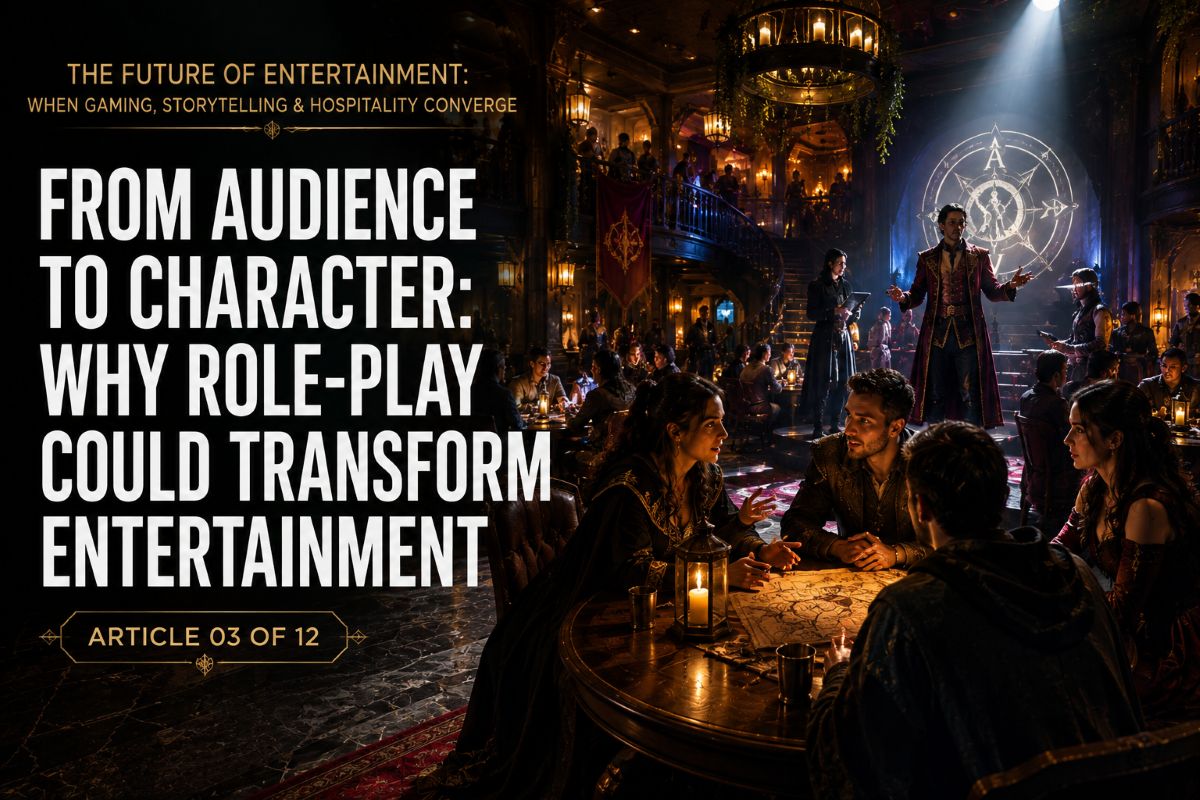
For most of entertainment history, the relationship between audience and character has been defined by identification at a distance: readers imagine themselves inside the consciousness of fictional people, theatre audiences observe human beings embodying characters before them, cinema uses performance, framing, music and editing to create extraordinary emotional intimacy, and television extends that relationship across months or years until fictional personalities can acquire the psychological familiarity of people we almost believe we know. Gaming altered that relationship by introducing agency, allowing players to influence events inside fictional environments, but role-playing games, live-action role-play, immersive theatre, interactive storytelling and experiential entertainment introduce an even more consequential possibility because they shift the central question from what the audience can make a character do to who the participant can temporarily become. For the future of entertainment, movie intellectual property and experiential hospitality, that movement from identification toward inhabitation may represent one of the most important transitions now taking place.
The significance of role-play is easily underestimated when it is reduced to costumes, theatrical performance or specialized gaming communities, because its deeper mechanism is psychological rather than cosmetic. Role-play provides a structured form of temporary identity in which participants are given permission to make decisions, develop relationships, pursue objectives and experience consequences from a position different from the one they occupy in ordinary life, creating a form of entertainment in which the self becomes part of the narrative machinery. Murder mystery experiences, tabletop role-playing games, immersive theatre, escape experiences and live-action role-playing may appear commercially and aesthetically different, yet they share a fundamental proposition: the participant is not simply watching the fictional world unfold but has been assigned, or has chosen, a meaningful position inside it. When that principle is combined with gaming mechanics, movie IP, interactive technology, themed environments, hotels and immersive hospitality, entertainment can begin moving beyond stories that surround audiences toward stories that actually incorporate them.
This transformation matters because fictional worlds become more psychologically powerful when participation is not merely possible but personally consequential. A guest who enters a hotel inspired by a cinematic universe can admire its architecture, recognize its visual references and enjoy the pleasure of proximity to a beloved story, yet the relationship remains fundamentally observational until the environment asks something of that guest that nobody else can answer in precisely the same way. The deeper opportunity begins when arrival creates identity, identity creates objectives, objectives create decisions, decisions alter relationships, and those relationships influence what the participant subsequently discovers, producing an entertainment structure in which the guest's own behavior becomes part of the experience. To understand why role-play could become one of the essential foundations of next-generation entertainment hospitality, we must therefore examine not simply how people play characters, but why temporary identity can produce emotional investment that spectatorship alone cannot replicate.

Unlock the Entire Empowering Entertainment Library
This article is only the beginning.
Become a member and enjoy unlimited access to every premium magazine article, expert interviews, in-depth features, practical guides, and a growing digital library of hundreds of books covering business, entrepreneurship, film production, personal growth, health, relationships, AI, ADHD, and much more.
One membership. Hundreds of resources. New content added every week.