
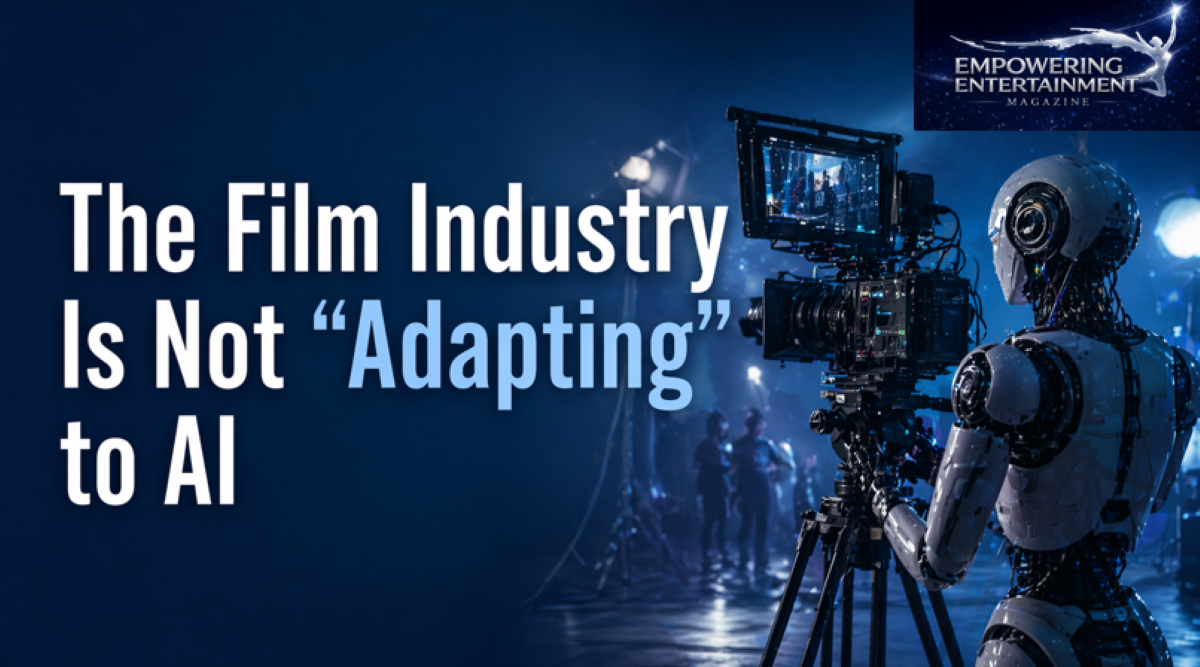
The Film Industry Is Not “Adapting” to AI
It Is Quietly Changing What Your Job Is Worth
A System That Still Moves—But No Longer the Same Way
From the outside, the film industry continues to project a sense of continuity that is both reassuring and misleading. Productions are still moving forward, crews are still being assembled, and development pipelines remain active enough to give the impression that, while the tools may be evolving, the underlying structure remains largely intact. For many professionals working within that system, this visible activity reinforces the belief that artificial intelligence is simply another phase of technological progress—comparable to the transition to digital editing, or the evolution of visual effects—something to integrate, adapt to, and eventually normalize without fundamentally altering how careers are built.
What is far less visible, however, is the degree to which the internal mechanics of that same system are already shifting. The change is not occurring at the level of output, where films continue to be made and distributed, but at the level of process, where the time, resources, and number of people required to achieve those outcomes are being recalibrated. Because that recalibration happens gradually, often within individual departments or workflows rather than across the industry as a whole, it does not immediately register as a structural transformation. Yet over time, these incremental adjustments begin to align, and what once felt like isolated improvements reveals itself as a coordinated shift in how value is assigned across the entire production chain.
The Real Shift Is Not Job Loss—It Is Value Loss
The conversation around artificial intelligence often focuses on the question of whether jobs will disappear, as though the primary risk lies in a future moment where entire categories of work are replaced outright. This framing, while understandable, obscures the mechanism that is already in motion, which is not the elimination of roles but the gradual reduction of their economic weight. When a process that once required significant time, coordination, and human input can now be completed more quickly, with fewer steps and less friction, the role attached to that process does not vanish. It continues to exist, and in many cases continues to be necessary. What changes is the amount of time allocated to it, the number of people required to perform it, and ultimately the budget that supports it.
This distinction is critical because it explains why the shift is so difficult to detect in its early stages. Professionals do not suddenly find themselves without work; instead, they experience a slow adjustment in the conditions under which that work is offered. Projects move faster, contracts become shorter, teams become leaner, and the margin for inefficiency disappears. Over time, the cumulative effect of these changes becomes significant, not because any single adjustment is dramatic, but because together they redefine what is considered normal. Once that new baseline is established, it is rarely questioned, and even more rarely reversed.
The Compression of Workflows and the Reduction of Teams
What artificial intelligence introduces into the film industry is a powerful compression effect that operates across multiple phases of production. Development cycles that once unfolded over extended periods are now accelerated through tools that assist with drafting, iteration, and concept exploration. Visual development, which traditionally required teams of artists working through multiple rounds of refinement, can now be initiated and advanced with far greater speed. Post-production workflows, long defined by time-intensive processes of sorting, assembling, and refining material, are increasingly supported by systems that reduce the manual burden at each stage.
The consequence of this compression is not a reduction in output, but a change in how that output is achieved. Fewer individuals are required to perform tasks that once justified larger teams, and the time allocated to each phase of production continues to shrink. This does not diminish the importance of expertise, but it alters the relationship between expertise and opportunity. Where there was once space for multiple contributors, there is now space for fewer, and where there was once time to learn, iterate, and refine, there is now an expectation of immediate efficiency. As these expectations become embedded in production culture, they reshape hiring decisions, budget allocations, and the overall structure of projects in ways that extend far beyond any single department.
The Pressure on the Industry’s Middle Layer
For decades, the film industry has operated through a layered structure that allowed professionals to progress from entry-level roles into positions of greater responsibility, eventually reaching levels of creative or executive control. This structure depended on a broad middle layer composed of roles focused on coordination, management, and the handling of complexity across departments. It is precisely this layer that is now under increasing pressure.
As workflows become more streamlined and processes more integrated, the need for coordination decreases. Tasks that once required multiple points of communication and oversight can now be executed more directly, reducing the reliance on roles whose primary function was to manage those interactions. The result is not an immediate disappearance of these positions, but a gradual narrowing of their scope and a reduction in their number. Over time, this creates a structural imbalance in which fewer opportunities exist at the mid-level, making it more difficult for professionals to establish stability or progress within the traditional career path.
This shift has implications not only for those currently occupying these roles, but also for those attempting to enter the industry. With fewer positions available at each stage, competition intensifies, and the pathways that once allowed for gradual advancement become less accessible. The industry does not close its doors, but it becomes more selective in ways that are not always immediately visible.
Creativity Is Not Being Replaced—But Its Position Is Changing
There is a deeply rooted belief within the film industry that creative roles are inherently protected from technological disruption, grounded in the understanding that storytelling, emotional nuance, and human intuition cannot be replicated by machines. While this belief remains valid at a fundamental level, it does not fully account for how artificial intelligence is reshaping the environment in which creativity operates.
AI does not replace the need for creative thinking, but it accelerates the processes that surround it. Ideas can be generated more quickly, visualized more easily, and iterated more frequently. As a result, the scarcity that once defined creative output begins to shift. When exploration becomes faster and less resource-intensive, the bottleneck moves away from creation itself and toward the ability to evaluate, select, and position ideas effectively within a project.
This shift changes where creative value is concentrated. Those whose role is primarily to generate content find themselves operating in a landscape where generation is no longer the limiting factor. Meanwhile, those who are involved in shaping direction, making decisions, and aligning creative output with broader strategic objectives become more central to the process. The distinction is subtle, but its implications are significant, as it redefines what it means to hold influence within a production.
An Industry That Is Changing Without Saying So
One of the most challenging aspects of this transformation is that it is not being openly acknowledged in a unified way. There is no single moment of transition, no clear declaration that the industry has entered a new phase. Instead, change is occurring through a series of individual decisions made across projects, companies, and departments, each of which appears reasonable in isolation.
A producer chooses to streamline development using new tools. A post-production team adopts a more efficient workflow. A marketing strategy integrates data-driven insights to refine targeting. None of these decisions, on their own, signal a structural shift. Yet collectively, they create a compounding effect that accelerates change across the entire system. As expectations adjust to these new efficiencies, they become embedded in the way projects are planned and executed, shaping the environment in which all professionals must operate.
The Illusion of Stability—and the Risk It Creates
Despite these underlying changes, the industry continues to appear stable, with ongoing activity reinforcing the perception that opportunities remain broadly available. This illusion of stability is particularly powerful because it allows individuals to continue operating within familiar patterns, even as the conditions that support those patterns are evolving. The risk, therefore, is not sudden disruption, but gradual misalignment.
Professionals may find that they are still working, still involved in projects, and still participating in the industry, yet experiencing a slow reduction in opportunity, compensation, or progression. Because this change is incremental, it is often attributed to external factors or temporary conditions, rather than recognized as part of a broader structural shift. By the time the pattern becomes clear, the gap between where the industry has moved and where the individual remains can be difficult to close.
A Transition That Requires More Than Awareness
Recognizing that this transformation is underway is an important first step, but it does not, in itself, provide protection. The fundamental question is not whether artificial intelligence will continue to reshape the film industry, but how individuals within that industry choose to respond to a shift that is already redefining where value resides.
The difference between those who navigate this transition successfully and those who struggle will not be determined by talent alone, but by positioning—by the ability to understand where influence, control, and long-term value are concentrating, and to move accordingly before those positions become saturated. This is not a matter of adopting new tools, but of rethinking one’s place within a system that is becoming more efficient, more selective, and less forgiving of roles that no longer align with its evolving structure.
What matters now is not simply recognizing that change is happening, but understanding exactly how it will affect your position before the effects become impossible to ignore. Because by the time most professionals fully realize what has shifted, they are no longer choosing how to respond—they are reacting to conditions that have already been set by others.
Inside the full piece, the conversation moves from what is changing to what actually holds value now, with a clear breakdown of which roles are gaining strength, which ones are being quietly compressed, and how to reposition yourself in a way that keeps you aligned with where the industry is going rather than where it has been.

Unlock the Entire Empowering Entertainment Library
This article is only the beginning.
Become a member and enjoy unlimited access to every premium magazine article, expert interviews, in-depth features, practical guides, and a growing digital library of hundreds of books covering business, entrepreneurship, film production, personal growth, health, relationships, AI, ADHD, and much more.
One membership. Hundreds of resources. New content added every week.